Counter

Search This Blog

Showing posts with label Leo Straus. Show all posts

Wednesday, October 20, 2010

The Politics of Obscurantism: Then You Control the Press


A CULTURE OF DEFIANCE: History of the Reform-Conservative Party of Canada
"Think of the press as a great keyboard on which the government can play.” - Joseph Goebbels
Stephen Harper's manipulation of the Press is legendary, and I've posted on it often.

But when viewed through the lens of Obscurantism, something a friend suggested I examine, everything becomes much clearer.

It ties Leo Strauss, neoconservatism and the Harper government together quite nicely.

Obscurantism is the art of obscuring the facts. It's deliberate and reaches to the emotions of the populace, rather than their intellect.

A normal political tool, but under Harper it has become an art form.

And to achieve this state, all messaging had to be controlled. But not to worry. They say it's for our own good.

A Crime to Practice Journalism
He held in his thin, knob-knuckled hands last week a new National Press Law making it a crime to practice journalism in Germany except as a licensed member of a nationwide closed shop. The law covers "all persons who take a share in forming the mental contents of any newspaper or political periodical through the written word or pictures." (1)
Harper's silencing of the press was not done with a National Press Law, but through a steady erosion of access. It started with the practice of not announcing cabinet meetings to avoid media scrums.
Harper never liked the tradition of holding media scrums after cabinet meetings. He started concealing the times of those meetings to keep his ministers away from the microphones. Cabinet and caucus members, with few exceptions, were instructed to avoid talking to the media without prior approval. At press conferences, Harper's office also wanted to control who asked questions. The press conferences were limited to specific issues as Harper did away with the wide-open meetings with the media, which had been a long-time custom ... (2)
Time magazine covered these "secret" cabinet meetings, and while legally the government had to announce them, Harper would wait until the meeting was well underway before meeting his legal obligations. And in describing one of those announcements:
...the veiled wording of the advisory--"There will be a Government media availability, today in the foyer of the House of Commons"--was almost Soviet in its stiff obfuscation ... Canadians should be worried when they see the government trying to exert such an unprecedented level of control." (3)
They also quoted Alasdair Roberts, a Syracuse University public-policy professor, who asked, "How can the average Canadian make a judgment about whether their government is being well run if they don't have access to the information?" (3)

Setting an Example

Walter Schwertfeger was a well-known Berlin journalist. When Joseph Goebbels, Minister of Popular Enlightenment and Propaganda, announced the new rules to the German media, Schwertfeger went public, venting with the foreign press.

For this he was charged with treason against the State and given a life sentence.
The case.. has been something of a sensation both in German and foreign newspaper circles, as well as diplomatic quarters in Berlin, because Walter Schwertfeger was understood to have been arrested for supplying foreign correspondents and diplomats with some confidential instructions isued to the German press by Dr. Joseph Goebbels, Minister of Popular Enlightenment and Propaganda ... Schwertfeger's sentence is the seventh passed thus far on Germans charged with the crime of supplying foreigners with any kind of information.

It is in line with the steady extension of the treason laws and practice of the People's Tribunal, designed to make the whole German nation a "community of oath-bound men" tightly shut off from prying 'foreign eyes, not only in respect to military affairs, but to all others as well. Particularly it may be assumed to represent a warning to all Germans not to give foreigners any kind of information, in order to shut off foreign observers here from their independent sources of information and restrict them to their official propaganda agencies. (4)
Stephen Harper began with warnings and then became more aggressive with the media if they dared to challenge him. When two journalists were held hostage on a plane (5), one of them David Aken, justified it by saying:
Harper's detractors may think we should just give the metaphorical finger to such directives from the PMO but, at one photo opp while we were here, a reporter who did just that and asked a question at a photo opp, despite warnings not to, was immediately warned that, if she continued, reporters would no longer be allowed to attend such photo opps. That would not be good for our access would be curtailed even further.

PMO staff also made veiled threats that that individual's organization might suffer further sanction -- all because of the impertinence of asking a question. If you are a media organization in Ottawa, these are no small consequences. (6)
And then there's those large RCMP bodyguards who make sure that reporters do as they're told. This video used to show Bob Fife being knocked to the ground, but was later edited, removing that part. More obstruction.


During the G-20, the media was targeted, beaten and arrested. Even Steve Paikin, one of the more conservative in the media was shocked. And he was not alone.
Reporters covering the G20 summit in Toronto say they were the target of police violence overnight, as riots blamed on anarchist groups left four police cars burning in the financial district and resulted in the arrests of some 150 people. "A newspaper photographer was shot with a plastic bullet in the backside, while another had an officer point a gun in his face despite identifying himself as a member of the media," reported the Canadian Press news agency. The agency did not say if it was its own reporters who were targeted.
The Huffington Post showed Brandon Jourdan being thrown to the ground and beaten by police while shooting video, and female journalists were threatened with rape.

And despite all this, the message was that Harper and his riot squad did a good job. The burning police cars were evidence that the one billion for security was money well spent. This even after the police admitted that they were told to stand down, and let the vandals do their job. Other video shows the police walking away from the carnage.
Who made the decision for police to stand down despite the fact the city was under attack? And why? Was it a police decision or political? These should be the cornerstone questions of an external review surrounding the chaos of the G20. After all, police officers were trained to stop the Black Bloc anarchists, were appropriately equipped and massively manned.

As downtown Toronto witnessed burning police cars and a small group of thugs on a rampage, a police source tells me the only thing that stopped the officers from doing that was an order telling them not to. They tell me they could have rounded up all, or most of them, in no time. I have had several frontline police officers tell me they were told not to get involved. But even before that decision was made, says one insider, there was mass confusion and indecision. (7)
All part of Obscurantism. Twisting the message by manipulating and then distorting the facts, while putting the media in it's place.

And Stephen Harper has not made one single statement to explain himself.

But then, he doesn't have to. We are the commoners who are "unworthy of knowing the facts".

Previous:

The Politics of Obscurantism: First You Obstruct

The Politics of Obscurantism: Next You Control the Message

Sources:

1. Foreign News: Consecrated Press, Time Magazine, October 16, 1933

2. Harperland: The Politics of Control, By Lawrence Martin, Viking Press, 2010, ISBN: 978-0-670-06517-2, Pg. 63-65

3. Controlling The Message, By Steven Frank, Time Magazine, April 03, 2006

4. REICH JOURNALIST GETS A LIFE TERM: Walter Schwertfeger Accused of Revealing Confidential Press Orders to Foreigners. Sentence Seen as Move to Bar Correspondents' Independent Sources of Information,
The New York Times, July 22, 1936.

5. Media have no flight plan on PM's plane, By James Fitz-Morris, January 29, 2010

6. Harper and the press gallery hit the road: 3 nights, 3 1/2 questions, By David Akin , January 29, 2010


7. Cops had hands 'cuffed, By Joe Warmington, Toronto Sun, June 30, 2010

Tuesday, May 11, 2010

Chapter Twenty-Six Continued: Minister of Propaganda and Public Enlightenment

A CULTURE OF DEFIANCE: History of the Reform-Conservative Party of Canada

Before club-footed little Dr. Paul Joseph Goebbels became Adolf Hitler's Minister of Propaganda and Public Enlightenment, he used to say that nothing was so good for a hostile editor as "one litre of castor oil." Lately Minister Goebbels' methods have grown less rudimentary. Last autumn, he "consecrated"' the German Press to Nazi service with a law that made it a crime to practice journalism in Germany except as a member of a nation-wide closed shop. (1)

The fact that Joseph Goebbels took complete control of the media in Germany should have been alarming to all German citizens. So why wasn't it?

Good Propaganda.

Good propaganda about the need for propaganda to be exact.

So much of the success of the neoconservative movement comes from deception, hidden meanings and yes even "doublespeak". And one common deceptive strategy is creating a persecution complex.

'Goebbels did not take over the media to control information. He did it because everyone else was against him'. But these claims wouldn't mean much coming from him so they had someone else come to his "defense". Enter Hans Fritzsche.

Hans George Fritzsche

"Nothing is more fatal to a people than the mania for great reforms, however excellent these reforms may appear theoretically." Gustave Le Bons

Han Fritzsche (1900-1953) was a Nazi propagandist working in the department of Joseph Goebbels, heading up the radio division. The image to the left was during his arrest but he was later acquitted because he had not taken part in the atrocities against Jewish citizens.

In fact, he tried to put a stop to their anti-Semitic publications. His interest was solely the movement and doing what he could to promote it and the German nation.

In 1934 Fritzsche wrote a piece defending Goebbel's ultimate control of the media, suggesting that his actions were necessary to counter liberal bias. Now he does blame the Jewish people to a certain extent, at least for their impact on the media.

But thanks to publications like the Protocols of the Elders of Zion; communism, liberalism and Judaism were all twisted to mean the same thing.

Dr. Goebbels and his Ministry
by Hans Fritzsche


It is but five minutes from the dark and smoky business office of 1926, which had the mocking name opium den, to the Leopold Palace. The road took Dr. Joseph Goebbels through a sea of poison and hate and lies. Each old follower of Adolf Hitler, each old National Socialist, had to withstand battles that no young party member will have to endure, no matter how long he lives. But no one had to face as much hate as Dr. Goebbels.

It was almost open season on Dr. Goebbels during the six-and-a-half year battle for Berlin. At first he was called the "Chief Crook of Berlin" by the Communists — a title he accepted without embarrassment and made a title of honor. Soon the middle class newspapers and speakers declared open season on him too. He is a man of sharp phrases and pitiless language. The danger he represented had long been recognized. The entire artillery of the political battle, for which any means is justified, was turned on him. (2)

"That took Goebbels through a sea of poison and hate and lies"?

In today's neoconservative propaganda it's called Liberal Media Bias and it's a myth now, just as much as it was a myth then. And yet it's used constantly .

Eric Alterman wrote a piece for Nation Magazine entitled What Liberal Media?, and even the neoconservatives he interviewed agreed that it was part of the "big lie"


Republicans of all stripes have done quite well for themselves during the past five decades fulminating about the liberal cabal/ progressive thought police who spin, supplant and sometimes suppress the news we all consume ... But while some conservatives actually believe their own grumbles, the smart ones don't. They know mau-mauing the other side is just a good way to get their own ideas across-or perhaps prevent the other side from getting a fair hearing for theirs. On occasion, honest conservatives admit this.

... That the media were biased against the Reagan Administration is an article of faith among Republicans. Yet James Baker, perhaps the most media-savvy of them, owned up to the fact that any such complaint was decidedly misplaced. "There were days and times and events we might have had some complaints [but] on balance I don't think we had anything to complain about" ... Patrick Buchanan, among the most conservative pundits and presidential candidates in Republican history, found that he could not identify any allegedly liberal bias against him during his presidential candidacies. "I've gotten balanced coverage, and broad coverage-all we could have asked.

And even William Kristol, without a doubt the most influential Republican/neoconservative publicist in America today, has come clean on this issue. "I admit it," he told a reporter. "The liberal media were never that powerful, and the whole thing was often used as an excuse by conservatives for conservative failures." (3)

Ari Fleisher defended George Bush's decision to only answer pre-scripted questions as necessary to combat Liberal media bias. Liberal media bias that doesn't exist.

And when Stephen Harper shut out the National Press gallery he stated:

Unfortunately, the press gallery has taken the view they are going to be the opposition to the government,” Harper told a London TV station. “They don't ask questions at my press conferences now. We'll just get the message out on the road. There's lots of media in the country who do want to ask me questions and hear what the government is doing.” (4)
Despite the fact that even foreign newspapers were writing about the unprecedented control of the government's message under Stephen Harper, he turned it around to play the victim.

Fritzsche continues:


The results of the unprecedentedly bitter battle the organs of the Weimar [Liberal] state and the parties were different than they had expected: He [Goebbels] hardened his weapons in the fire of this battle, and the masses his enemies attempted to mobilize against him instead joined him. It is not surprising that those who feared the oncoming National Socialism attacked with poison and gall.

It is surprising that this man, mocked, ridiculed and insulted as no one else, did not fall into deep despair and spiritual misery after those years of struggle. (2)

It was and is a war of their own creation, and yet they play the victim masterfully.

So, what's with all the whining? It's all about preventing the media from doing their job. If reporters are allowed to ask questions and rebut spin, then the Conservatives' disinformation campaign is much less likely to succeed.

And, by planting the seed of the notion that there is a media bias against his government, Harper has already achieved two related objectives. First, he is making the media more likely to be over-cautious about any appearance of bias, which will lead to more favourable coverage. Likewise, when the media does get around to reporting on his government's failures, voters may well dismiss the reports as one more example of the media conspiracy against the Conservatives. (4)

Chapter Twenty-Six Continued: Law, Justice and the Reichstag Fire

Sources:

1. Nazi Merger, Time Magazine, December 11, 1933

2. Hans Fritzsche, "Dr. Goebbels und sein Ministerium," Munich: Verlag Max Steinebach, 1934, pg. 330-342.


3. What Liberal Media? by Eric Alterman, The Nation magazine, February 24, 2003

4. The media conspiracy against Stephen Harper, By Scott Piatkowski, June 1, 2006

Chapter Twenty-Six: Joseph Goebbels and Manipulating the Masses

A CULTURE OF DEFIANCE: History of the Reform-Conservative Party of Canada

"What do close advisers to Stephen Harper and George W. Bush have in common? They reflect the disturbing teachings of Leo Strauss, the German-Jewish émigré who spawned the neoconservative movement." Donald Gutstein (1)

Those words are certainly true but I would also ask another question. What does Leo Strauss and the advisers to Stephen Harper and George W. Bush have in common? They reflect the disturbing philosophy of Joseph Goebbels. And most of Joseph Goebbels brilliance as a propagandist came from reading Gustave Le Bon, and exploiting his study of mass mentality.

Gustave points out that individuals in a crowd may range in intellect, but when presented as a mass to a common cause they become homogenized: In the collective mind the intellectual aptitudes of the individuals, and in consequence their individuality, are weakened. The heterogeneous is swamped by the homogeneous, and the unconscious qualities obtain the upper hand ... This very fact that crowds possess in common ordinary qualities explains why they can never accomplish acts demanding a high degree of intelligence ... In crowds it is stupidity and not mother-wit that is accumulated. (2)

Hence the notion of not just the "masses" but the "ignorant masses", reduced to ignorance by a common agitator.

Leo Strauss would develop a philosophical argument which he called Reductio ad Hitlerum which included playing the Hitler card. But Strauss also contends that not everything Adolf Hitler did was bad, so it would be wrong to conclude that something is bad just because Hitler did it. Actions can become "darkened by the shadow of Hitler" he warned.

So when neoconservative philosophy is attributed to Strauss, it's OK. He taught at American universities, and no matter what he taught it is legitimized. But as soon as you compare neoconservative principles to Joesph Goebbels, they cry foul, despite the fact that much of what Strauss taught is pure Nazi propaganda, that has been "darkened by the shadow of Hitler". And of course also darkened by the shadow of the Holocaust.

I'm not going to deny that Leo Strauss was a brilliant man, but I believe that in many ways he was simply the conduit for Goebbels, which is why so many legitimate followers of Strauss will question much of what has been attributed to him, especially when it comes to the actions of the Bush administration.

In chapter twenty four I drew several comparisons to Goebbels and the Neocons, but in this chapter I'm going to remove the shadow of Hitler and the Holocaust and outline the techniques used by the ultimate propagandist, Joseph Paul Goebbels. The similarities between him and the advisers of most neoconservative politicians are simply too vast to ignore.

Phenomena of a Hypnotic Order


The difference between Leo Strauss and Joseph Goebbels, is that Strauss's theories were philosophic, while Goebbels were scientific. Strauss was inspired by other philosophers while Goebbels was inspired by a scientist, Gustave Le Bons.

As Le Bons himself states: I have endeavoured to examine the difficult problem presented by crowds in a purely scientific manner—that is, by making an effort to proceed with method, and without being influenced by opinions, theories, and doctrines. (2)

So scientifically speaking, when discussing crowd mentality,he suggests that individuals in the crowd are rendered unconscious, and it is this unconsciousness that becomes their collective strength. They are now devoid of reason and this is the best state for a skillful orator to do their work. Le Bons refers to this as the 'phenomena of hypnotic order'.

So ideally when trying to stir up the masses, you need to get them into an hypnotic state, and one way of doing this is with hand gestures. In the "mesmerizing trade" it's referred to as Covert Hypnotism. Goebbels mastered it. Look at his rhythmic hand gestures. Very unusual.

Of course Goebbels would say that the power comes from the "harmony of word, facial expressions and gestures", but at this particular rally he speaks of the mass as being in a state of "total spiritual mobilization". Aka: hypnotized.


Now watch Adolf Hitler, doing the same thing. He starts out in a humble stance and then builds up the momentum. But again watch his hands (Not too closely though. I wouldn't want you to start clucking like a chicken or anything)


The gravelly voice was the result of mustard gas during the war and Hitler's first handler, Dietrich Eckart taught him how to use it to his advantage. But every now and then he has to stop to cough. Eckart was a playwright and stage director, so gave him a flair for the dramatic.

Now just as kind of a funny aside, following is a video of Stephen Harper. I don't really know what his oratory style is because he rarely speaks to us, and certainly would not speak to us in this manner if he thought we were listening. This video was shot on the QT. But watch his hands and yes I am LMAO.


Chapter Twenty-Six Continued: Minister of Propaganda and Public Enlightenment

Sources:

1. Harper, Bush Share Roots in Controversial Philosophy. The Tyee, Donald Gutstein, November 29, 2009


2. A Study of the Popular Mind, By: Gustave Le Bon, Book One: The Mind of Crowds

Monday, May 10, 2010

Chapter Twenty-Four Continued: Controlling the Masses

A CULTURE OF DEFIANCE: History of the Reform-Conservative Party of Canada

He who controls the medium controls the message. He who controls the message controls the masses.
Joseph Goebbels

The notion of mob mentality is nothing new. Perhaps the best example is mustering armies for war. Soldiers become indoctrinated into not only hating their enemies but more importantly fearing them.

And while on the battlefield it becomes kill or be killed, to get men and women onto the battlefield, and with the acceptance of the public, there also has to be the fear that if you don't kill the enemy they will come after everything and everyone you love. So it now becomes noble. And if you can vest it with a "holy" purpose (and religious fervour), all the better.

But I'm getting into the "big lie" and "total war" later. I just wanted to briefly discuss one of the most powerful tools of the Neoconservative movement: Controlling the masses.

Leo Strauss considered this to be essential for success. He referred to us as the "ignorant masses", Friedrich Von Hayek called us "the wandering herd". To Goebbels we were simply "the masses".

But none of their theories were really ground breaking. In fact, many originated with a man by the name of Gustave Le Bon (in photo), a French social psychologist, sociologist and author of A Study of the Popular Mind.

Joseph Goebbels used his book religiously and Mussolini kept a copy of it beside his bed.

Le Bon discusses how varied individuals in a crowd are, and yet when they have a common goal or purpose, they become a single entity.

"... there is in no sort a summing-up of or an average struck between its elements. What really takes place is a combination followed by the creation of new characteristics, just as in chemistry certain elements, when brought into contact ... combine to form a new body possessing properties quite different from those of the bodies that have served to form it.

It is precisely these general qualities of character, governed by forces of which we are unconscious, and possessed by the majority of the normal individuals of a race in much the same degree—it is precisely these qualities, I say, that in crowds become common property. In the collective mind the intellectual aptitudes of the individuals, and in consequence their individuality, are weakened. The heterogeneous is swamped by the homogeneous, and the unconscious qualities obtain the upper hand.

This very fact that crowds possess in common ordinary qualities explains why they can never accomplish acts demanding a high degree of intelligence. The decisions affecting matters of general interest come to by an assembly of men of distinction, but specialists in different walks of life, are not sensibly superior to the decisions that would be adopted by a gathering of imbeciles. The truth is, they can only bring to bear in common on the work in hand those mediocre qualities which are the birthright of every average individual. In crowds it is stupidity and not mother-wit that is accumulated. (1) (all emphasis mine)

Hence crowd mentality is based on the intellect of the lowest members, and the real genius is in reducing the intellectuals to that lowest level. In that way, you are then superior to them all.

Goebbels understood that. Mussolini understood that. And Guy Giorno understands that.

"He Who Controls the Message, Controls the Masses"

In 2000, Ryerson Press published a lengthy article about former Ontario Premier Mike Harris and his unprecedented control of the media:
TV newsmakers need vivid images to illustrate their stories. Harris's Tories, easily the most communications-savvy provincial government this country has ever seen, are delighted to oblige — on their terms. They dodge negative coverage at every chance and will go to ridiculous lengths — giving preferential treatment to friendly reporters, shutting out critical ones and staging elaborate, unrelated events — to avoid it. Because they know the demands of getting on the news are a lot like the demands of the Miss Universe pageant: you've gotta be sexy, you've gotta have charm and you've better have something interesting (but not too complicated) to say.

With expectations so superficial, many television journalists are losing the incentive and initiative to go out and chase stories beyond the pre-packaged photo ops offered up by government communications staff. Even if they want to go beyond these prefab items, with shrinking political reporting staff and dwindling resources, they can only pursue one or two stories a day. Government PR people know this and are prepared to make it easy for journalists to get their precious pictures, provided the coverage doesn't end up being too hard on them. The result is political coverage that serves no purpose other than promoting a government that's already very good at promoting itself. (2)
(all emphasis mine)
A message that is not too complicated with the right images to sell it to the "ignorant masses".

And the man behind this unprecedented control was Guy Giorno.

Governing for the Camera

That Stephen Harper has become the king of the photo-op is no longer debatable, but I think a good example of how he governs for the camera, is the handling of the Haiti crisis, which also leans toward the deception category.

Journalist Mia Rabsan wrote a column for the Winnipeg Free Press: Stop the photo op already, in which she says:

Late last night we got a photo from the prime minister's office of Stephen Harper on the telephone, presumably with UN secretary general Ban Ki-moon, discussing the situation in Haiti. Today Defence Minister Peter Mackay is posing in Halifax as the HMCS Athabaskan and HMCS Halifax leave for Haiti. At about the same time, Prime Minister Stephen Harper and his wife, Laureen, were staging a photo op making a donation to the Canadian Red Cross.

Enough already. Stop posing for photo ops and just get on with the business of helping Haiti. Canadians want to know the ships are on their way and what we're
sending so we know Canada is doing what it can to help. A photo op of a minister can do little but delay the voyage.

The Canadian response to Haiti thus far has been prompt and thorough. Let's stop the photo ops and just keep the aid flowing. (3)

At the time Rabsan, like most Canadians, allowed the photos to tell the story. However, what we learned later, was that the whole thing was fabricated for political gain. The ships in the photo with MacKay did not have the much needed medical supplies, food and water that Harper assured us had been loaded. In fact they arrived almost empty.
OTTAWA — When HMCS Athabaskan and HMCS Halifax were ordered to sail on a humanitarian mission to Haiti on Jan. 13, they worked through the night, passing boxes hand to hand, loading stores aboard the ships — everything they would need for the humanitarian mission.

But sailors didn’t take aboard much in the way of relief aid — food packages, medical supplies or shelters — for distribution to Haitians. During the voyage, some sailors wondered if the ships might have been better off staying in port a little longer — say 12 hours — to take on more relief supplies, food aid and medical equipment before sailing for Haiti. (4)
And two months after Rabsan wrote her story, the promised funds had not been delivered. Not one single penny. We might ask ourselves how that could be. We saw Stephen Harper handing over a cheque.
I called the agency yesterday with questions about the Haiti Earthquake Relief Fund. You probably remember this. It’s where the Canadian government promises to match funds Canadians donate to Haiti to help with, among other things, “early recovery” and reconstruction. I had heard from a contact who does relief work in Haiti that no one who has applied for money from this fund had heard back from CIDA. Seemed a little strange. It’s been two months since the quake and one month since the donation window closed on February 12.

... I asked how much of the money raised through the Haiti Earthquake Relief Fund has been spent. CIDA’s response included a paragraph about where Canada has spent money that doesn’t come from the Haiti Earthquake Relief Fund, before adding the line: “Funds from the Haiti Earthquake Relief Fund will be disbursed in the near future.” (5)
You see it wasn't about handling the Haiti crisis, but the appearance of handling the Haiti crisis. And the man behind this unprecedented media control is Guy Giorno. (6)

Chapter Twenty-Four Continued: Higher Learning

Sources:

1. A Study of the Popular Mind, By: Gutave Le Bon, Book One: The Mind of Crowds


2. How Mike Harris and his minions manipulate TV news, Ryerson Press, Summer 2000

3. Stop the photo op already By: Mia Rabson, Winnipeg Free Press, January 14, 2010

4. Chronicle Herald

5. CIDA’s Haiti Earthquake Relief Fund: millions raised, nothing spent.
by Michael Petrou, Macleans, March 10, 2010


6. Ex-aide to Mike Harris to run PM's office: The aide embroiled in 'NAFTA-gate' is out; to be replaced by former Harris chief of staff, By: Richard Brennan and Susan Delacourt, Toronto Star, May 22, 2008

Saturday, May 8, 2010

Chapter Twenty-Four: Reductio ad Hitlerum and Propaganda

A CULTURE OF DEFIANCE: History of the Reform-Conservative Party of Canada

Though Leo Strauss would eventually be forced into exile, finding safe harbour in the United States, he would not simply denounce Nazism out of hand. Not that he supported the Holocaust, but he did hold some admiration for the regime.

In fact he would later state that he tried to join the Nazi Party when he was younger, but was turned away because he was Jewish.

Strauss would develop a philosophical argument which he called Reductio ad Hitlerum.

What he suggested was that not everything Adolf Hitler did was bad, and using examples like Hitler was anti-smoking, loved dogs and was a vegetarian, we can't automatically think of those things as bad, just because they were associated with Hitler.

I'm going to get into this in another chapter, but I wanted to point out that Leo Strauss and the Nazi propagandist Joseph Goebbels, both supported and even encouraged deception. For Strauss it was the "Noble Lie", for Goebbels, the "Big Lie". And whether he realized it or not, Strauss had been deceived here.

Hitler was not a vegetarian (1), but loved wild game, sausages and caviar. However, the image of a vegetarian was created as part of his public persona. The same goes for his love of dogs. He often had a dog, but there are several stories about how he would brutally beat them. Robert Waite mentions one in his book; The Psychopathic God:

Heinrich Hoffmann’s daughter, for example, remembered clearly that when she was a 15-year-old in pigtails and flannel nightgown, Hitler, who was visiting their home, asked for a good-night kiss. When she refused, he beat his hand viciously with his whip. In 1926, apparently in order to impress Mimi Reiter, a 16-year-old girl, he whipped his dog so savagely that she was shocked by his brutality. (2)
However, I wanted to use this argument to discuss propaganda. Leo Strauss would write in Natural Right and History:

In following this movement towards its end we shall inevitably reach a point beyond which the scene is darkened by the shadow of Hitler. Unfortunately, it does not go without saying that in our examination we must avoid the fallacy that in the last decades has frequently been used as a substitute for the reductio ad absurdum: the reductio ad Hitlerum. A view is not refuted by the fact that it happens to have been shared by Hitler. (3)

The problem with trying to draw parallels between Adolf Hitler and George Bush or Adolf Hitler and Stephen Harper, is that people will go right to the Holocaust, and you're accused of hyperbole. But while Hitler will definitely "darken the scene", we need to look at the propaganda techniques used by the Neoconservative movement, which was founded by Leo Strauss and adhered to by both George Bush and Stephen Harper.

They are pure Joseph Goebbels, and the new masterminds are people like Ari Fleischer and Guy Giorno.

I'm going to present arguments to support my theories, but when I accuse Fliescher and Giorno of following Goebbels, it's not a "slippery slope" and I am not playing the Hitler card. it was brilliant strategy so why wouldn't it be copied?

William Aberhart would fashion his control of the media from that of Adolf Hitler, but it was never as finely crafted as it has been with the Neoconservatives. And William Aberhart never had a sinister agenda.

Chapter Twenty-Four Continued: Language Guidance

Sources:

1. Hitler: Neither Vegetarian Nor Animal Lover, By: Ryn Barry, Pythagorean Books, 2004

2. The Psychopathic God: Adolf Hitler, By: Robert G.L. Waite, Basic Books, 1977, ISBN-10: 0306805146


3. Natural Right and History, By: Leo Strauss, University Of Chicago Press, 1999, ISBN-10: 0226776948

Saturday, April 10, 2010

Book Two Introduction: From Movement to Political Party

A CULTURE OF DEFIANCE: History of the Reform-Conservative Party of Canada

Despite his best efforts, William Aberhart would never really succeed in adopting Social Credit principles. And even though his party was called Social Credit, their governing was based on theology, and a form of Social Conservatism emerged, that became increasingly cult-like.

Individuals were discouraged from thinking for themselves. They didn't need to understand what he was doing, they were just to simply follow him and he would lead them to glory. And if there were any doubters, they would be set to right in one of his radio broadcasts.

He was soon directing every aspect of their lives from the pulpit, and it often had devastating results. If he was fanatical before, he became worse, especially if he felt his power was being threatened.

His protege, Ernest Manning; would use similar techniques as he broadcast his own Bible Hour, hammering out his government's position. And like Aberhart before him and all those after; he allowed no dissent. While many credit him with purging the party of it's anti-Semites, it was only because they were putting pressure on him to start adopting the monetary reforms of Clifford Douglas.

So the purge was not a magnanimous gesture, but was simply for political expediency.

And the basic principles of this movement have not changed. There has always been a radical religious element that directs most of their policy making, coupled with an extreme prejudice against anyone who doesn't believe as they do.

They demonize their enemies and use fear mongering, intimidation and emotional blackmail to get what they want. And despite the liberal use of the words 'freedom' and 'democracy', they oppose those notions with a vengeance.Theirs is a one party state:


"We don't need an opposition," Ernest Manning has said. "They're just a hindrance to us. You don't hire a man to do a job and then hire another man to hinder him." (1)

So Now What?

In the first part of this book, I wanted to tell the stories of contemporaries William Aberhart, Adolf Hitler and Leo Strauss, since all play a very huge role in the Social Conservative (Reform) movement, that brought Stephen Harper and his "reinvented" Conservative Party to power.

We have to remember that as this story has unfolded so far, few imagined that anything as horrific as The Holocaust could have taken place.

But both Hitler's German Worker's Party and Aberhart's Social Credit Party, were grounded in anti-Semitism and the notion of an international Jewish conspiracy.

Both blamed the Jewish people for many of their ills, and both came to power and held onto power, based on fascist style governing.

You can see from the cartoon of Stewart Cameron's, which was published in the 1930's; that it was not unusual to compare William Aberhart to both Mussolini and Hitler, and many newspaper columns reflected the same observation.

At the peak of the depression, everyone was looking for answers. Radical governments were on the rise, all promising to create stability out of chaos, and lead their people from the wreckage.

What has happened in modern times, is that we only judge Adolf Hitler and the Nazi Regime, from their darkest days. And believe me, they don't get much darker. On the other hand, history has tended to forgive William Aberhart, and yet there was a time, when he also plunged Alberta into darkness.

Nothing to the extent of the Holocaust, but damaging none the less.

So that is where my story will continue, as fascism becomes the norm. And remember, Leo Strauss was nurtured on this authoritarian style, and once regretted that he was not allowed to join the Nazi party because he was Jewish.

Book Two Introduction Continued: Konrad and Adolf

Sources:

1. Texas of the North, Time Magazine, September 24, 1951

Wednesday, April 7, 2010

Chapter Nineteen Continued: Leo and Carl

A CULTURE OF DEFIANCE: History of the Reform-Conservative Party of Canada

Carl Schmitt, was a German philosopher, law professor and devout anti-Semitic. On May 1, 1933; he joined Adolf Hitler's National Socialist German Workers' Party or NSDAP (name changed from simply German Worker's Party) and was quickly appointed to the position of Prussian State Counselor by Hermann Göring.

He was also made the president of the Union of National-Socialist Jurists and it is believed that many of his theories became the ideological foundation for a Nazi dictatorship, and the basis for it's extreme authoritarianism.

Professor Alan Gilbert wrote recently of Schmitt:

There is a kind of darkness here that emanates from his writing and penetrates the reader. As a longstanding fighter against the pseudoscience of eugenics, ingredient to IQ testing, and Nazism, I thought myself pretty steeled (so far as one can be) against lethal anti-semitism. But Schmitt’s Catholic and medieval anti-semitism I found hard to absorb – it has a creepiness, an indiscriminate murderousness, and a demonism about “masks” which goes right to the gut. (1)

As chairman of a law teachers' Convention in Berlin in October 1936, Schmitt demanded that German law be cleansed of the "Jewish spirit" and future publications by Jewish scientists be marked with a small symbol.

The Beginnings of a Strange Relationship:

In 1926, Schmitt had published one of his most famous works: The Concept of the Political, that very much impressed the budding Jewish philosopher, Leo Strauss.

Strauss would send Schmitt a list of comments and criticisms, that so inspired him that he would make changes in future editions based on Leo's notes. He just wouldn't acknowledge that they came from him.

The two men did engage in regular correspondence, and Carl Schmitt was instrumental in Strauss' receiving a Rockefeller Fellowship *, enabling him to leave Germany for Paris, thereby escaping the fate of many others. At that time, they broke off their relationship and Strauss wrote from Paris fuming that Schmitt would not acknowledge his contribution to the later editions. He obviously forgot that he was Jewish and how the other man felt about Jews. (1)

However, Strauss would later tell a girlfriend, Hannah Arendt, that "he wanted to join a party which would not have him because he was a Jew." This of course was the Nazi Party. Strauss says of Hitler, that his “political theology” was hostile toward “me and my kind,” but Gilbert suggests that Strauss was not put off by Schmitt’s anti-Semitism because Strauss, too, had quite a streak of it. (1)

Many have suggested that Neoconservatism, based on Leo Strauss's teachings, was deeply influenced by Carl Schmitt. This authoritarian nature has certainly been adopted by neocon leaders like George Bush and Stephen Harper**.

However, while Strauss is often blamed for the actions of the Bush administration, there are at least some who attribute them to Schmitt himself.
"... although some analysts have suggested that the Bush Administration has operated under the guidance of the ideas of German emigré Leo Strauss, it seems far more plausible to suggest that the true éminence grise of the administration, particularly with regard to issues surrounding the possible propriety of torture, is Schmitt."

In a similar vein, Scott Horton, chairman of the International Law Committee of the New York City Bar Association and adjunct Professor at Columbia University published a note on "Balkanization" on Nov. 7, titled "The Return of Carl Schmitt." In discussing Justice Department lawyer John Yoo's advice that the Executive Branch was not bound by the Geneva Conventions and similar international instruments in its conduct of the war in Iraq, Horton writes, "Yoo's public arguments and statements suggest the strong influence of one thinker: Carl Schmitt." (2)
Schmitt died on April 22, 1985, and his obituary appeared in Time Magazine:

DIED. Carl Schmitt, 96, controversial German legal and political philosopher, sometimes called the Crown Jurist of the Third Reich, whose pro-authoritarian theories of government profoundly influenced the course of his country; in Plettenberg, West Germany. From 1929 to 1933, he provided legal and theoretical justifications for the Hindenburg government's dictatorial emergency decree system. Schmitt warned against a Nazi takeover, but his right-wing views became identified with the movement, and when Adolf Hitler took power in 1933, Schmitt opportunistically switched with the tide, becoming Prussian state councilor under Hermann Goring. He avoided prosecution as a war criminal at Nuremberg and later largely kept his vow to retreat "into the security of silence." (3)

Chapter Twenty: Mixed Blessings

Footnotes:

*Heinrich Meier wrote a book on the shared philosophies of the two men: Carl Schmitt and Leo Strauss: The Hidden Dialogue

** According to Donald Gutstein in his piece Harper, Bush Share Roots in Controversial Philosophy: "What do close advisors to Stephen Harper and George W. Bush have in common? They reflect the disturbing teachings of Leo Strauss, the German-Jewish émigré who spawned the neoconservative movement."

Sources:

1. Enmity and Tyranny, By: Alan Gilbert, March 5, 2010

2. Dick Cheney's Éminence Grise, by Barbara Boyd, Executive Intelligence Review, January 6, 2006

3. Milestones: Apr. 22, 1985, Time Magazine

Tuesday, April 6, 2010

Chapter Sixteen Continued: The Beer Hall Putsch

A CULTURE OF DEFIANCE: History of the Reform-Conservative Party of Canada

Soon after joining the German Worker's Party, Adolf Hitler suggested that they change their name to the National Socialist German Worker's Party. Not because he was embracing socialism, but because he remembered the passion of the socialist groups in Vienna, and he thought that they could tap into that.

They had also learned how to use the press to their advantage, by making Hitler's Brown Shirts visible. Constant marches and rabble rousing, kept their name and images in the newspaper, and they were able to feed off that notoriety.

Not that they didn't meet with opposition. After hearing Hitler speak, Konrad Heiden, then a university student, tried to organize against them:

In 1923, as the leader of a small democratic organization in the University of Munich, I tried, with all the earnestness of youth, and with complete lack of success, to annihilate Hitler by means of pro test parades, mass meetings, and giant posters. And so I am entitled to call myself the oldest - or one of the oldest anti-Nazis now in the United States, for there cannot be many in this country who came into conflict with Adolf Hitler and his handful of followers at: so early a date.

Those who experience history and have a share in its making rarely see the enduring threads but only the whirl of exciting and quickly forgotten details. In 1920, and the years following, my friends and I certainly did not view our modest fist-fights and other encounters with the National Socialists as an attempt to put a premature end to the career of the modern Genghis Khan, and I would have jeered at anyone who had prophesied that this was the beginning of a new epoch in world history. (1)
It was actually Heiden who first gave them the name Nazi, a Bavarian slang word meaning "country bumpkin". He would later infiltrate the group as they marched toward a beer hall in Munich, ready to overthrow the government and seize power in November of 1923.

The Beer Hall Putsch

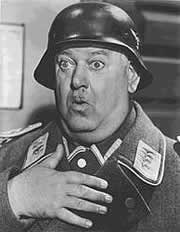
Besides a large following and a platform, the 'Nazis' (country bumpkins) also had their own little army under the leadership of General Ludendorff * (who reminds me of Sergeant Schultz from Hogan's Heroes), and their own newspaper. It was time.

They chose the five year anniversary (November 9, 1923) of the abdication of Kaiser Wilhelm and prepared for battle in his name.

Under cover of darkness General Erich von Ludendorff, flagitious, inscrutable, unrelenting, sallied forth into the streets of Munich, capital of Bavaria, accompanied by his faithful Austrian, Herr Adolf Hitler, to make a coup for the Hohenzollerns by way of celebrating Nov. 9, the fifth anniversary of the abdication of the then Kaiser of Doorn.

With unerring instinct they led their men to a beerhouse, called the Bügerbrau Keller, famed Bavarian cellar. Within was Bavarian Dictator von Kahr, Minister President von Knilling, Minister of Interior Schweier and some others. Dr. von Kahr was in the middle of outlining his state policy in which he denounced Marxism, when the door opened and in walked Herr Hitler and General von Ludendorff with some of their followers, who fired a few shots into the ceiling by way of effect.

Herr Hitler declared the Bavarian Government had been superseded and elected himself not only head of Bavaria but Chancellor of all Germany.

Dr. von Kahr was offered the post of National Protector, à la Horthy in Hungary, which he accepted. His companions, Minister President von Knilling and Minister of Interior Schweier, were arrested and imprisoned. General Ludendorff was given command of the Army, which he accepted, and said: "We have reached the turning point in the history of Germany and the world. God bless our work!"

After this distribution of gifts by fairy godfather Hitler, there was wild talk of a march on Berlin, the destruction of the Treaty of Versailles, the deposition of President Ebert and the Berlin Government.

Everything seemed to be " going " well enough. The people cheered Ludendorff when he swaggered in or out of anywhere. The Hitler storm troops were in possession of the city and the sun was shining brightly on the following day. " Chancellor" Hitler and " Commander-in-Chief" von Ludendorff were within the War Office when the loyal Bavarian Reichswehr, commanded by the " disloyal" (to Berlin) General von Lossow, stormed the building, and after a short battle the "beer hall revolt" was crushed.

It appeared that Dictator von Kahr and General von Lossow were entirely out of sympathy with the movement and declared that their agreement with the Hitler move was forced by duress. After leaving the Bürgerbrau Keller, Dr. von Kahr had conferred with General von Lossow and they decided to suppress the revolt with the faithful Reichswehr (defense force). Ex-Bavarian Crown Prince Rupprecht, head of the Wittelsbach dynasty, emphatically repudiated the revolutionary movement.

In Berlin the news of the coup was received with undisguised alarm, despite subsequent contrary statements. President Ebert issued an appeal to the nation, an emergency Cabinet meeting was held, troops were ordered out by General von Seeckt, Commander-in-Chief of the Reichswehr. Hardly had this been done when the news was flashed from Munich that the revolt had been crushed.

Meanwhile in Munich Dr. von Kahr and General von Lossow quickly restored order. Minister President von Knilling and Minister of Interior Schweier were released and resumed their duties. Herr Hitler escaped from his enemies without hurt, but was found several days later hiding in the house of one, Ernst Franz Hanfstaengl, said to be a Harvard graduate and former Manhattan art dealer.

Ludendorff was captured by the Reichswehr, but released after having given his parole not to plot against the Bavarian Government. Once free, however, he determined not to become the scapegoat of a beer-house brawl. With characteristic defiance he declared that he was bound only by his honor to refrain from attacking the Government while his and Hitler's conduct were under consideration. Beyond that he considered himself free to work for the Hohenzollern's return.

Thus it was clear that the career of a great German general is not over; that his iron fist, which proved stronger than that of Generalfeldmarschall von Hindenberg during the latter part of the War, is not rusty; that he is still intent upon being treated as a monster and not a weakling, a soldier of the old brigade and not a great pure fool. Perhaps, next putsch, he will not frolic with political opportunists such as Hitler. (2)

Also involved in the Putsch, were Dietrich EcKart, who was arrested and imprisoned, but later released due to poor health. He died of a heart attack on December 23, 1923. And Max Scheubner-Richter, who walked arm-in-arm with Hitler as they marched toward laying claim to Berlin (yes, it would be a very long march). He was shot and killed, but took Hitler down with him, who dislocated his shoulder as he fell.

Hitler would indeed hide out in the home of Ernst Franz Hanfstaengl, a close confidante. But Ernest wasn't there. He had also taken part in the beer hall revolt, and had escaped to Austria. But Hitler spent the time with his wife, and when the police came to arrest him, it is said that she talked him out of committing suicide.

Many people who write the story of Adolf Hitler and the Nazi party will cite many times when Hitler could have been stopped, and this is one of them. However, I don't believe that would have made much of a difference. This was a very powerful movement, and if not Hitler, then it probably would have been someone else.

But his arrest and subsequent conviction, only made him appear as a martyr for the cause, and though the movement was forced underground, Hitler's popularity continued to grow. He had created a charismatic cult, and the powerful forces driving the party, knew how to exploit it.

Chapter Seventeen: Martians and Evil Bankers

Footnotes:

* WWI veteran, General Erich Friedrich Wilhelm Ludendorff

Sources:

1. Der Fhehrer, Hitler's Rise to Power, By: Konrad Heiden, Houghton Mifflin Company, 1944, Preface

2. Beer Hall Revolt, Time Magazine, November 19, 1923