 A CULTURE OF DEFIANCE: History of the Reform-Conservative Party of Canada
"We stand for the maintenance of private property ... We shall protect free enterprise as the most expedient, or rather the sole possible economic order." - Adolph Hitler
In David McGowan's book; American Fascism and the Politics of Illusion, he claims:
The current political system in place in the United States at the dawn of the twenty-first century is fascism. Of course, we don't like to call it that. We like to call it democracy. Nonetheless, it looks an awful lot like fascism, though to understand how this is so requires an awareness of what fascism actually is.So how will historians view this period in Canadian history from the outside, with the benefit of hindsight?
We don't like to use the f-word at all. It tends to conjure up unpleasant images. Our perceptions of fascism are shaped both by the very real horrors of the Holocaust, and by the fictional worlds created by writers with British and American intelligence connections like Aldous Huxley and George Orwell. These are the images that our schools and our media provide for us.
So when we think of fascism, we think of concentration camps filled with corpses and horribly decimated walking skeletons. We think of a stiflingly regimented society in which 'Big Brother' watches our every move. We think of brutal pogroms by jackbooted thugs, and violent repression of dissenting views.
These images are so far removed from the world that we live in that we cannot conceive that our system of governance could have the remotest resemblance to that which was in place in Nazi Germany. The problem is that fascism, viewed from the inside through a veil of propaganda, rarely looks the same as it does when viewed from the outside with the benefit of historical hindsight. (1)
McGowan wrote when George W. Bush was in the White House, but he felt that his country had been drifting toward fascism for some time, under the guise of anti-Communism and 'Western Democracy'.
And as he suggests, to really understand you have to remember what fascism really is. Adolf Hitler was a fascist. But he was not deemed a fascist throughout most of his political career because of the Holocaust or any notion that such an atrocity was possible. He was a fascist because he was a capitalist who believed in an authoritarian style of government to prevent Germany from drifting into Communism or socialism, the two things he detested the most.
And he didn't feel that a Liberal Democracy was capable of fending off the threat.
He was not really anti-Semitic until he believed the claims that the Jews were working with the Communists. In his early life, his roommates were Jewish, including his best friend. Much of what was in Mein Kampf was fabricated to create a persona.
And in what McGowan calls the 'Politics of Illusion', Adolf Hitler the man did not have as much power as history has given him. Most of the major decisions were out of his hands.
In 1936, American columnist Heywood Broun wrote:
"Fascism is a dictatorship from the extreme Right, or to put it a little more closely into our local idiom, a government which is run by a small group of large industrialists and financial lords ... I am going to ask latitude to insist that we might have Fascism even though we maintained the pretense of democratic machinery. The mere presence of a Supreme Court, a House of Representatives, a Senate and a President would not be sufficient protection against the utter centralization of power in the hands of a few men who might hold no office at all. Even in the case of Hitler, many shrewd observers feel that he is no more than a front man and that his power is derived from the large munitions and steel barons of Germany."Ian Kershaw in his book, Hitler: Profiles in Power (2), agrees. And he states that if you read articles of the day, especially coming from the Soviets, they refer to him as a 'Capitalist'. And all of the real power in Nazi Germany was in the hands of the boys in the backroom. "... in the hands of a few men who might hold no office at all."
Who Are You Calling a Fascist?
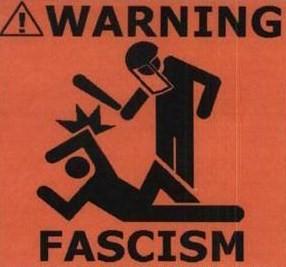
To prove his theory, McGowan points to several aspects of American politics that define fascism, and we have comparisons here under Stephen Harper. And remember, this is based on the definition of political fascism and has nothing to do with the Holocaust. And as McGowan says: "To most of those living in Germany during the reign of the Third Reich, fascism didn't look the way that we think it is supposed to look either."
We could argue that the two most common descriptions of fascism: one-party dictatorship and forcible suppression of opposition, are a bit difficult to prove. However, Harper has certainly blurred the lines between party and state, and has suppressed opposition by making Parliament toxic, and shutting it down when he's losing control.
But we can't argue the third point: 'Private economic enterprise under centralized government control'. Guy Giorno, the man with more power than Stephen Harper, is a lobbyist. In fact, he's one of the top lobbyists in Canada. And he is the one deciding who gets what. He has centralized power to the PMO and every decision made is based on what's good for "free enterprise", or what Hitler himself called "the sole possible economic order".
In theory, at least, there is supposed to be centralized control over private enterprise, to enforce such concepts as fair labor standards, environmental protections, and anti-trust legislation. In truth, however, the heads of corporate America are also its heads of state, and are essentially regulating themselves. Or, more accurately, failing to do so.The latest Omnibus bill removes all environmental standards and our safety standards were already traded away at Montebello.
But the point is that the way the system is supposed to work is for private enterprise to be under federal regulation. The federal government is supposed to rein in monopoly corporate power and guarantee that workers and the environment get a fair shake, in addition to setting monetary policy. (3)
The next point validating fascism that McGowan points to is "belligerent nationalism". Leo Strauss, the father of neoconservatism, to which Stephen Harper prescribes, calls for three main components. Deception, Religious Fervour and unbridled patriotism through perpetual war.
The main deception, I suppose, is the illusion of democracy and the religious fervour was well outlined in Marci McDonald's Armageddon Factor. Frank Lutz, the Republican pollster who has helped Stephen Harper along the way, suggested that he tap into Canadian symbols, like hockey. You'll notice that he does that every chance he gets.
But belligerent nationalism, fuelled by unbridled patriotism, is what can bring a nation to accept extreme acts of inhumanity, when it's wrapped up in God and Country. As McGowan relates before the current wars in Iraq and Afghanistan.
In Canada we have our own "yellow ribbon" campaign, which not surprisingly came from the same ad firm, Hill and Knowlton. And we have our own chest thumping and cheering, forgetting that most of the people killed are civilians, many of them children.When I think of belligerent nationalism, I think back to early 1991, a time when it was not possible to drive even a few blocks to the local video store without passing a stream of American flags and yellow ribbons flapping in the wind. A time when one couldn't turn on the television without seeing a mob of people in a field somewhere creating a giant human American flag. I think of the pompous theme music and 'Desert Storm' miniseries style graphics on CNN, and the relentless braying of military and government hacks as they barely contained their exuberance while discussing 'sorties,' 'air supremacy,' and 'smart bombs.' I think of a nation so inflated with its own sense of self-importance and self-righteousness that it openly cheered each airing of sanitized video footage of bombing attacks on largely defenseless civilian targets.
And then I think that while America was busy patting itself on the back and beating its chest, the conditions were being created that would result in the deaths of as many as 2,000,000 Iraqis, over 60% of them children under the age of ten. That's over a million children, for anyone who's counting. And not one of them had anything to do with the planning or execution of the annexation of Kuwait. Nor were any of them involved in the building of any 'weapons of mass destruction,' or the oppression of the Kurdish people of Iraq. But they're all dead now.
And then I think back to December of 1998, and recall how the press whipped the people into a frenzy by literally demanding the further mass bombing of Iraq. Saddam had not learned his lesson, we were told, and needed a further show of America's resolve to enforce 'humanitarian' standards and the 'rule of law.' And so a nation that had just a decade before been the most socially advanced in the Middle East, with the highest literacy rate and the best schools, the best healthcare and quality of life, and the most advanced civilian infrastructure—and which now was reduced to abject poverty and rampant disease—would once again be bombed.
Once again toxic agents such as depleted uranium would be rained down indiscriminately. And once again chemical sites on the ground would be targeted, poisoning the land and the air, threatening food and water supplies, and killing the hopes and dreams of the Iraqi people that their children wouldn't be joining their friends and classmates who had already perished. And, sadly, once again the American people would cheer. That, my friends, is what you would call belligerent nationalism. (5)
When Rick Hiller said that they were "not civil servants but were trained to kill people", Jack Layton said that he was offended. From that day on he has been dubbed "Taliban Jack", in a you're with us, or against us mentality. "That, my friends, is what you would call belligerent nationalism".
McGowan next mentions racism, including "immigrant bashing." The Reform Party was notorious for racist comments, but under their new name, the Conservative party of Canada, they've toned it down, though mainly because they've been completely muzzled. But we are starting to see the signs, especially recently, with Jason Kenney and Stockwell Day threatening to put an end to affirmative action.
But perhaps the most compelling of McGowan's arguments, that is now becoming the norm in a country not know for such tactics, is the "militarization of the police" and the accelerated use of "Paramilitary police squads."
That one should hit you right between the eyes. It started at Montebello, with the use of tear gas and rubber bullets, after police provocateurs provided reasons to use them. And they got away with it.
Now they no longer need a reason.The security at the Vancouver Olympics was described as "one of the largest security operations taking place on Canadian soil." In fact, it ended up being the largest to date of any Olympics anywhere. It was said that there were so many police along the fence that they totally blocked the view. Total cost was 900 million dollars.
And then there was the G-20, where the police were told to leave vandals alone and instead targeted civilians, even in the designated protest zones. And they used provocateurs. Total cost 1.3 billion dollars.
And most recently in Kingston when protesters tried to block the sale of the cattle from the prison farms. We have never seen this many police officers in one place, since the prison riots, decades ago. Even an 87-year-old woman was hauled off by police.
There is a clear message here. This is not a government that allows dissent.
Now you might not want to call it the F-Word, but it sure as HELL IS NOT DEMOCRACY!!!!
Sources:
1. Understanding the F-Word: American Fascism and the Politics of Illusion, By David McGowan, Writers Club Press, 2001, ISBN: 0-595-18640-8, Pg. 3
2. Hitler: Profiles in Power, by: Ian Kershaw, Longman House UK, 1991, ISBN: 0-582-08053-3
3. McGowan, 2001, Pg. 8
4. McGowan, 2001, Pg. 10-11