Counter

Search This Blog

Showing posts with label Neoconservatism. Show all posts

Sunday, July 31, 2011

REAL Women, Promise Keepers and the Promotion of Violence


I Burned my Bra For This? REAL Women of Canada and the Men Behind Them
It is a massive masculine shadow,
in a hall or crowded room,
lifting something indistinct up into the resonating night.
ROBERT BLY, "FIFTY MALES SITTING TOGETHER"
Robert Bly is an American author and poet who became the inspiration for the Mytho-poetic men's movement.

Fearing that the women's movement was turning men into "yogurt-eaters", Bly was determined to instead create a cabal of "wild men", who would seek traditional roles for the male species, many based on, believe it or not, Grimm's Fairy Tales.

The tales that portray the powerful king, the handsome prince, the beautiful maiden, and of course the witch determined to destroy them all. (He must have some mother issues)

No "round shouldered" men need apply.

Author Susan Faludi attended one of his few retreats that were open to women and asked why everyone was told in advance to bring a large stone. Bly's spokesperson explained that they were to build a monument to Hermes, but didn't want to go into too much detail, with women present.

An Olympic god. Of course. Patron of shepherds and cowherds. In fact, the spokesman, Walter Bliss, had legally changed his name to Shepherd Bliss, and his profession from army officer to psychologist.

Bly made his appearance to the sound of conga drums, and with the stance of a Viking, reminded those in the audience that he is Norse.
We no longer have images of "real men," Bly says, as the men continue the drum beat. Stereotypical sissies have replaced macho men. "Woody Allen is just as bad—a negative John Wayne," he says, raising his voice to a nasal squeak in imitation. "Men used to make models for what a man is from the Iliad and the Odyssey and places like that."

On the all-male weekend, he promises, he will bring back these role models for male edification: "One of the things we do is go back to the very old stories, five thousand years ago, where the view of a man, what a man is, is more healthy."
(1)
A former peace activist, and strong opponent to the Vietnam war, Bly needed a new cause and found it in male bonding.
By the early '80s, he was, he confessed, starting to feel less than manly. "I began to feel diminished," Bly writes, "by my lack of embodiment of the fruitful male—or the moist male." It wasn't his loss of early prominence, however, that he identified as the problem. It was his "missing contact with men" and his overexposure to strong and angry women, including his own mother. (told 'ya)

He feared that he and men like him had allied them­selves too closely with such women, and consequently taken "a female view" of their fathers and their own masculinity. He de­cided he'd made a mistake with his earlier recommendation: "If someone says to me now, 'There is something missing on your feminine side,' I say, `No, what is missing is the masculine,' " Bly told Whole Earth magazine in 1988. He worried that he was only "superficially" manly. Men had awakened their feminine princi­ple only to be consumed by it. They had gone "soft." (1)
So he began running all-male workshops to reintroduce men to "the deep masculine."

This led to wilderness weekend retreats where men dressed in tribal masks and wild-animal costumes, beat drums and rediscov­ered "the beast within." His success inspired scores of imitators, creating a "cottage industry" for the men's movement.

And one of those "imitators" was the Promise Keepers. A New Age Journal article noted that Promise Keepers combined the secular men’s movement (founded by New Age poet Robert Bly) with the political evangelicalism of Pat Robertson. And the Atlanta Journal-Constitution stated that: "Promise Keepers combines the Jesus Saves preaching of Billy Graham with the male-bonding message of Robert Bly.

Promise Keepers was brought to Canada by Conservative MP David Sweet. In 2004, when he ran, he posted on his website, the fact that he had been instrumental in creating the Northern chapter.

Women read that, reminded us of what PK stood for, and he lost the election.

In 2006, he got smarter, and removed all mention of the "wildmen" club, only saying that he ran a non-profit organization. He continues to represent Ancaster-Dundas-Flamborough- Westdale.

Bly's teachings also fit well with the anti-feminist groups, like REAL Women of Canada, who promoted so-called "family values". Bly attacked not only domineering women, but single mothers.
In short, the Great Mother's authority has become too great. "Men's societies are disappearing, partly under pressure from women with hurt feelings," he writes. Too many women are "raising boys with no man in the house." The single mother's son has become "a nice boy who now not only pleases his mother but also the young woman he is living with."

To restore the nice boy's male identity, Bly proposes, he must quit taking cues from mother and "go down into the psyche and accept what's dark down there." As a key guide to the journey, Bly offers "The Story of Iron John," borrowed from a Grimm's Brothers' fairy tale. In the story, a hairy "wild man" is locked up in an iron cage near the royal castle; the key to the cage is under the queen's pillow. One day the young prince loses his prized "golden ball" when it rolls into an abandoned pond, and he can only relieve it by stealing the key from mother and freeing the wild man. The young man, in the words of Bly's sidekick Keith Thompson, has to take back the power he has given to his mother and get away from the force field of her bed. He must direct his energies away from pleasing Mommy." (1)
At Bly's all-male weekends, the "wildmen" build lairs with plastic chairs, grunting and groaning, and whatever other male sounds they can muster.

Journalist Jon Tevlin, attended a weekend of frolic and fun, run by Bly, at a Bible camp in Mound, Minnesota. On the first night, Tevlin reports that Shepherd Bliss, dropped to his knees.
"Some of you may want to temporarily leave the world of the two-leggeds, and 'Join me in the world of the four-leggeds," he said. One by one, we slid from our orange Naugahyde chairs onto an orange shag carpet ripped straight out of the 1960s. "You may find yourself behaving like these four-leggeds; you may be scratching the earth, getting in contact with the dirt and the world around you."

As he spoke, people began pawing at the ground. . . . "You may find yourself behaving like the most masculine of all animals—the ram," Shepherd said in a coaxing voice. . . . "You may find unfamiliar noises emerging from your throats!" . . . There were gurgles and bleats, a few wolf calls. . .. Out of the corner of my eye, I saw Shepherd coming toward me, head down, tufts of white hair ringing a bald spot. . . . Meanwhile, I felt a slight presence at my rear, and turned to see a man beginning to sniff my buttocks. "Woof!" he said.
(1)
"Woof" indeed!

How to Handle Your Women

As men are given instruction on how to find their "beast within", they are also told how to treat their women, and "wrest the power from their hands".

Inspiration came from objects they were asked to bring from home, including a .380-caliber automatic pistol. A rather odd trophy for a what was called a "battle on the domestic front".

And what if women are not so enthused with their new butt sniffing menfolk?

Promise Keeper's Tony Evans says “I am not suggesting that you ask for your role back, I am urging you to take it back. There can be no compromise here.” .

Robert Bly is not so subtle.

At one seminar, with more than a thousand men in attendance, a man in the audience told Bly, "Robert, when we tell women our desires, they tell us we're wrong." To which Bly responded: "So, then you bust them in the mouth." (1)

People are not taking this movement seriously enough. Stephen Harper is tearing down the Status for Women, and reversing gains made over the past decades.

But the media look at all the women in his caucus, and determine that he is not a misogynist.

If we had to select one photo that would define this period in our history, the following would definitely be in the running.

A frightened Diane Finlay making an announcement, with Pierre Poilievre in a Gestapo style stance, watching on. Women in Harper's party are mere window dressing. They have no power.


When Jason Kenney rewrote the citizenship guide, he all but excluded any contributions made by women.

Historian Margaret Conrad said of the new guide, that it “represents a new kind of Canada, one that is less sympathetic with my personal sense of a progressive, forward-looking nation, but the new slant is no doubt in keeping with the sentiments of the current administration in Ottawa ... It's kind of like a throwback to the 1950s, ... It's a tough, manly country with military and sports heroes that are all men."

We are being written out, reduced to the "witches" in Grimms Fairy Tales.

Sources:

1. Backlash: The Undeclared War Against American Women, By Susan Faludi, Crown publishing, 1991, ISBN: 0-385-42507-4, Pg. 304-312

Friday, July 22, 2011

Gary Bauer's Focus is the Harper Government's Vision


I Burned my Bra For This? REAL Women of Canada and the Men Behind Them

Another soldier in the war against American women, who helped to the launch a similar war against Canadian women, is Gary Bauer.

Bauer was with the Moral Majority/Religious Right political movement, that helped to run Ronald Reagan's campaign for President. As reward, he was appointed to the Education Department, as the "family policy" czar, and his first order of business was to "usurp the feminists" (1).

With that accomplished, the Department of Education, then directed the effort to crown the fathers. As Susan Faludi said, "If the "pro-family" movement was "pro" anything, it was paternal power". The same has been said of REAL Women of Canada. (2)

To many, the creation of a "family policy" office would suggest an office committed to helping families with things like financial aid, and medical or legal assistance, but that was not the case. Instead they churned out lectures on how the American family should "behave".

And in a further attack against the Civil Rights movement, Bauer told civil-rights leaders: "The values taught on the `Cosby' show would do more to help low-income and minority children than a bevy of new federal programs. . . . a lot of research indicates that values are much more important, say, than the level of welfare payments."

Not everyone could accomplish what the Huxtables accomplished, with a doctor father and lawyer mother, and that includes most white families. However, the Religious Right's attitude on racial issues has not changed since Reagan's time, as witnessed by their latest offspring, the FAMILY LEADER, and their suggestion that slavery was good for the black family.

However, women and blacks were not the only targets of Bauer's office"
[In 1986] President Reagan asked the surgeon general [C. Everett Koop] to prepare a report on AIDS as the United States confirmed its ten-thousandth case. Leaders of the evangelical movement did not want Koop to write the report, nor did senior White House staffers ..... Dr. Koop related to me, "Gary Bauer was my nemesis in Washington because he kept me from the president. He kept me from the cabinet and he set up a wall of enmity between me and most of the people that surrounded Reagan because he believed that anybody who had AIDS ought to die with it. That was God's punishment for them. (3)
Gary and Carol Bauer: Your Typical American Family

Bauer's office promoted the nuclear family, as laid out in a fifty-two-page diatribe, that senator Daniel P. Moynihan, referred to as "less a policy statement than a tantrum."

"The Family: Preserving America's Future" opens with a quote from Teddy Roosevelt: "If the mother does not do her duty, there will either be no next generation, or a next generation that is worse than none at all." The pages were filled with attacks on "women who work, women who use day care, women who divorce", and "women who have babies out of wedlock".

His "recommendations" to save the family included a list of punishments for girls and mothers: "bar young single mothers from public housing; revive old divorce laws to make it harder for women to break the wedding bonds; deny contraceptives to young women". Mothers who stay home, he suggested, should get tax breaks; "the more babies, the more credits".

With such strong opinions you would think that Bauer and his wife Carole, were living this desired family life. But they weren't.
It comes then as a bit of a surprise to learn that Bauer has subjected his own children to this leftist institution—for nine years. (Bauer called daycares "Marxist")

He can explain it, he says. His use of day care was "different" and "better" because he placed his children in "home-based" day care—that is, an unlicensed center run out of a woman's living room. (It's unclear how this is better: a national review of child abuse statistics at day care centers finds that the most incidents of abuse have occurred at such unlicensed sites.) At any rate, Bauer says, a bit defensively, it's not like his kids went directly from the maternity ward to the day care nursery. His wife, Carol, waited "at least three, four months" before she returned to work.
(1)
However, wife Carol remembers it differently:
"Actually, I went back to work six weeks after Elyse was born," says his wife ... At the time of her daughter Elyse's birth in 1977, Carol Bauer explains, she was a top assistant to Congresswoman Margaret Heckler; she couldn't just quit.

A lack of federal assistance programs for mothers also played a role in her decision: "There's no set leave policy on the Hill," she points out. Financial considerations entered into it, too: "We had bought a house and we had a mortgage." And then there was that other impulse that she just couldn't seem to squelch: "It wasn't just economics. I enjoyed the intellectual stimulation of the work. I loved work." She laughs. "I mean, when I had Elyse, I literally took my work with me. After I got out of the hospital, I was working the next day at home."

For years, at eight o'clock every morning, the Bauers dropped off Elyse, and eventually their second daughter, Sarah, at day care, put in a full day of work, and then picked up the girls on the way home, usually after six o'clock. The children spent so much time at day care, in fact, Carol Bauer says, that when it came time for Elyse to enter kindergarten, they enrolled her in the school in the center's neighborhood rather than their own. How did the girls feel about day care? "Oh, fine," Carol Bauer says. "They were very happy there. For them it was normal."
(1)
Like Beverly Lehaye, one of the founders of REAL Women's inspiration: 'Concerned Women for America', Carol Bauer only felt fulfilled when she was working outside the home. When she finally did drop out of the workforce, Bauer found "nesting" difficult, and was only happy when she spent most waking hours doing volunteer work.

Oh, and that "family values" man, Gary Bauer.

He was alleged to have had an affair with a 26-year-old staffer (deputy campaign manager Melissa McClard), prompting nine members of his staff to quit. He denied that it was an affair, but Charles Jarvis, Bauer's campaign manager, warned Bauer several times "in the clearest possible terms" that he was creating "the appearance of impropriety" by spending "hours and hours and hours behind closed doors with a young single woman."

Canada's "family values" man, Vic Toews, lost his deniability rights, when it was revealed that he had fathered a child with a young conservative staffer, breaking up his 30 years plus marriage.

From Women's Affairs to Foreign Affairs

"For Harper, the courtship of the Christian right is unlikely to prove an electoral one-night stand. Three years ago, in a speech to the annual Conservative think-fest, Civitas, he outlined plans for a broad new party coalition that would ensure a lasting hold on power. The only route, he argued, was to focus not on the tired wish list of economic conservatives or “neo-cons,” as they’d become known, but on what he called “theo-cons”—those social conservatives who care passionately about hot-button issues that turn on family, crime, and defence.

"Even foreign policy had become a theo-con issue, he pointed out, driven by moral and religious convictions. “The truth of the matter is that the real agenda and the defining issues have shifted from economic issues to social values,” he said, “so conservatives must do the same.

"Arguing that the party had to come up with tough, principled stands on everything from parents’ right to spank their children to putting “hard power” behind the country’s foreign-policy commitments ... "
(4)
Gary Bauer continues to work the circuit of anti-feminist, anti-gay conferences, where REAL Women of Canada make regular appearances.

REAL also promotes Bauer's new group: American Values, in his attack on "leftie" judges.

Bauer is associated with Focus on the Family, a group that conservative MPs, Rob Anders and Maurice Vellacott belong to, and who helped Stephen Harper get elected in 2006, on his "anti-same-sex marriage" platform.

But the most alarming activities for Bauer, and indeed most of the Religious Right, is their dramatic shift to foreign policy.

Bauer is a member of the Project for the New American Century, that included neoconservatives like Steve Forbes, Dick Cheney, Richard Perle and William Kristol. This group helped to draft the Bush Doctrine.

They have been critical of Obama's decision not to send ground troops to Libya, instead following the UN Resolution, which does not support a "regime change".

The Harper Doctrine has no such limitations, and in fact is very specific that only a regime change will do.

However, even more alarming is Bauer's new pet project: Emergency Committee for Israel's Leadership, an aggressive extension of Christians United for Israel, who support extended military engagement in the Middle East.

Jim Flaherty's pal, Charles McVety, heads up the Canadian chapter.

This group, like most in the movement, are Apocalyptic.

So what does it mean when they not only provide foot soldiers for Harper's war on women, but dictate his foreign policy? Or what Harper himself calls 'putting “hard power” behind the country’s foreign-policy commitments'.

Yet another reason why the media has to start paying attention.

Drop the 'Tory' nonsense, and report from the Neoconservative/Religious Right/Tea Party reality.

Sources:

1. Backlash: The Undeclared War Against American Women, By Susan Faludi, Crown publishing, 1991, ISBN: 0-385-42507-4, Pg. 263-267

2. "R.E.A.L. Women, Anti-feminism and the Welfare State, By Lorna Erwin, Resources for Feminist Research, 1988

3. Faith in the Halls of Power: How Evangelicals Joined the American Elite, By D. Michael Lindsay, Oxford University Press, 2007, ISBN: 978-0-19-532666-6

4. Stephen Harper and the Theo-cons: The rising clout of Canada's religious right, By Marci McDonald, The Walrus, October 2006

Wednesday, July 20, 2011

From Forlorn to Forbearing: Feminism Never Stood a Chance


I Burned my Bra For This? REAL Women of Canada and the Men Behind Them

We all remember the scene in When Harry Met Sally, when Meg Ryan shows Billy Crystal how easy it is for a woman to fake an orgasm, and another patron declares "I'll have what she's having".

It was probably the funniest scene in the movie, but not everyone was laughing.

Two years before the movie's release, in November of 1987, Shere Hite published the last installment of her national survey on sexuality and relationships, Women and Love: A Cultural Revolution in Progress, and the reaction from the male population was immediate.

The media, unable to dispute the findings, since they were testimonials from flesh and blood women, instead attacked Hite personally, as a man hating flake.

I doubt many read all 922 pages, representing the views of 4,500 women, so instead thumbed through the summaries, questioning the numbers.

They also accused Hite of only distributing her questionnaires through women's rights groups, but that was not the case. Hite sent her surveys through a wide range of women's groups, including church societies, social clubs, and senior citizens' centers. And while their views were dismissed as "man-bashing diatribes", they sounded more forlorn than vengeful.

So why the uproar?

Says Susan Faludi, in her book Backlash: The Undeclared War Against American Women: "the overheated denunciations of Hite's book suggest an emotion closer to fear than fury."

Hite revealed that women were more likely to experience orgasm through masturbation than intercourse, and panic set in. Test-tube babies were already a reality, so the fear for some men would be that they might be deemed to be obsolete.

A ridiculous assumption, but one shared by many just the same. Canadian neoconservative Link Byfield, spoke at a REAL Women of Canada conference, relating his fears"
To populate the nation, society has implemented the ideas set out in Aldous Huxley's book, "Brave New World." For example, we are increasingly playing with providing babies in nurseries without mothers and fathers and families, just as predicted by Mr. Huxley ...
Fortunately, most men don't really feel that way, enjoying more intimacy in an equal partnership, but it helps to reveal some of the fears, neocon males have of "radical feminists".

If women can support themselves, pleasure themselves, have and raise children themselves, where do they fit in? Will they have to audition for a place in society that they were once guaranteed, simply because of their maleness?

The Strange Case of Srully Blotnick

Eventually Shere Hite was forced to leave the United States and become a German citizen, she was so vilified.

And yet another expert on women, who was releasing the results of his survey, was glorified by the media. Srully Blotnick, a columnist for Forbes Magazine.
Blotnick asserted that his twenty-five-year study of 3,466 women proved that achieving career women are likely to end up without love, and their spinsterly misery would eventually undermine their careers as well. "In fact," he wrote, "we found that the anxiety, which steadily grows, is the single greatest underlying cause of firing for women in the age range of thirty-five to fifty-five." He took some swipes at the women's movement, too, which he called a "smoke screen behind which most of those who were afraid of being labeled egomaniacally grasping and ambitious hid."
Dr. Blotnick appeared everywhere and was quoted often. And his testimonials were not deemed to be female-bashing diatribes, but legitimate views of working women.

And Forbes magazine paid him hundreds of thousands of dollars to produce still more studies about these "anxiety-ridden careerists". But there was a problem.

First off, if Blotnick had really been compiling his data for 25 years, using interviews with women, as he claimed; it would have meant that he had began when he was only 17. How many women are going to open up to a 17-year-old boy, about their anxieties over working outside the home, while still being expected to perform 80% of the domestic duties.

Or about their sexuality?

The biggest problem, however, was that Dr. Blotnick was not a doctor at all. His degree had been acquired through a correspondence course, and was not recognized anywhere. When the news broke, Forbes had him remove the "Dr." from his byline, but continued to print his columns.

And the media continued to quote him everywhere.

Why Was Forbes so Interested?

Eventually Forbes magazine did fire Blotnick, after a criminal investigation for practicing psychology in New York, without a license.

But why was a business rag so concerned with women's rights, that they poured so much money into this man's "research"? Keeping him on even after learning that he had lied about his credentials?

To understand the motivation of Forbes magazine is to understand it's editor-in-chief, Steve Forbes, a card carrying member of the Neoconservative movement.

Grandson of the magazine's founder, Forbes used the publication to endorse Ronald Reagan, and when Reagan became president, he brought Forbes into his administration as head of the Board of International Broadcasting.

Steve Forbes took a run at the presidency on his own, but failed. However, he continued to work behind the scenes, in many think tanks and AstroTurf groups, the most famous being the American Enterprise Institute for Public Policy

Alykhan Velshi, Jason Kenney's former puppet master, was plucked from there to help put words into Kenney's mouth, and keep the boys in the backroom "election ready". However, now that Harper has a majority, Velshi has left, his work here apparently done.

AEI also helped to draft the "Clash of Civilizations" foreign policy, which according to Lawrence Martin in his book Harperland, is something that Stephen Harper has embraced.

The American Right has been the driving force behind Canada's movement for decades.

In fact, Steve Forbes was key adviser to Christie Todd Whitman's 1993 run for New Jersey governor, transforming her from "plain old Christie Whitman to a Christian Coalition Republican" (CNN Crossfire, January 20, 2000).

He brought on board some Republican heavyweights, including strategist Mike Murphy, who drafted a "common sense" revolution, with the promise of a 30 percent cut in New Jersey's income tax. As a result she beat out the incumbent Governor James Florio.

So successful was the campaign that the Neocons decided to replicate it, transforming plain old Mike Harris into "a *Christian Coalition Republican".
Whitman defeated a popular Democratic incumbent, Jim Florio, primarily on the basis of a Murphy-inspired campaign using a "common sense" slogan and pledging a 30 per cent tax cut. Since her victory, the activities of her government in implementing this plan had been carefully charted by Harris aide Bill King. In March 1994, Harris actually travelled to New Jersey to meet Whitman and discuss strategy. Two months later, the "Common Sense Revolution" with its 30 per cent tax cut was unveiled. (Hard Right Turn: The New Face of Neo-Conservatism in Canada, Brooke Jeffrey, Harper-Collins, 1999, ISBN: 0-00 255762-2 4, Pg. 166)
The Undeclared War Against American Women, is now the well documented War Against Canadian Women.

And the American neoconservative movement has expanded it's mandate, making Canada Chapter Twenty-two of The Shock Doctrine.

They didn't need a bloody coup to achieve their goals, only a willing partner, and no one was more willing than Stephen Harper.

When is our media going to wake up? The evidence is so overwhelming, that it is hitting them between the eyes, knocking them on the head and kicking them in the groin. Yet they still choose to ignore it, preferring instead to believe that Harper was sprinkled with happy powder and instantly turned into a "Tory".

A miracle only rivalled by those witnessed at Sainte-Anne-de-Beaupré.

Another man behind REAL Women of Canada was the late Ted Byfield. When Harper cancelled the Court Challenges program, Byfield wrote under the headline: Canadian Tories pull rug from feminist-gay revolution (World News Net, September 30, 2006)
Whether the challenges program is gone for good is, of course, still in doubt. It survived its last demise under Mulroney, [Lorne] Gunter recalls, by kicking up such a squawk that even the Tories themselves promised to revive it if returned to office. But the Conservatives of those days were the so-called "Red Tories," a species to which Harper & Co. do not belong.

Moreover, the conservative lobby groups are now considerably better organized. The SOW had barely got started in its mass-mailing campaign against the Harper axe when Gwen Landolt of the conservative REAL Women organization, pounced on them for using government funds to influence government policy. Her swift response was typical. It has been REAL Women, totally self-financed by thousands of members, which more than any other group finally put the boots to these detestable agencies. May they stay dead.
There is no argument that we've "had the boots put to us", but the question is: When are we going to start kicking back?

Footnotes:

*Later brought to Canada by Jason Kenney and company. Kenney would also use his Canadian Taxpayers Federation to endorse Mike Harris.

Tuesday, July 5, 2011

The Neoconservative Passion for Alexis de Tocqueville

A CULTURE OF DEFIANCE: History of the Reform-Conservative Party of Canada

Neoconservative doctrine was written by academics and based on the writings of scholars, from Plato to Aristotle, Locke to Rousseau, and everything in between.

But one of the scholars often quoted, is Alexis de Tocqueville, a nineteenth century political thinker, who like many shaping the minds of young neocons, was born into wealth as a member of the aristocracy.

And he wrote of poverty as a man who had never known it, only observed it, yet his 1835 Essay on Pauperism, is used to justify the right's reluctance to help the poor.

What Tocqueville saw as a basic problem, was the definition of poverty.
"Among civilized peoples, the lack of a multitude of things causes poverty... In a country where the majority is ill-clothed, ill-housed, ill-fed, who thinks of giving clean clothes, healthy food, comfortable quarters to the poor? The majority of the English, having all these things, regard their absence as a frightful misfortune; society believes itself bound to come to the aid of those who lack them.... In England, the average standard of living a man can hope for in the course of his life is higher than in any other country of the world. This greatly facilitates the extension of pauperism in that kingdom."
So poverty is a state of mind? A comparative?

If our poor people are better off than the poor in central Africa, are they really poor?

Imagine going to your boss and asking for a raise and she tells you that you are already overpaid when compared to workers in Third World countries.

But workers in Third World countries aren't spending $1.30 a litre for gas to get to work, or 8 bucks for a box of cereal.

The definition of poverty has to be relative to how the rest of the population lives.

I'm not a socialist, and don't believe that if one family has a wide screen TV, then all families should have a wide screen TV.

However, I do believe that in a country with such vast natural resources as Canada, that everyone should be clothed, fed and housed. And everyone should have equal access to healthcare and education.

Neoconservatives do not.

David Frum is right when he says that government should never protect us "against the miseries caused by idleness", but is wrong when he says that only the indigent, or most destitute in society should be given handouts.

Remember the old Chinese proverb: “Give a man a fish; you have fed him for today. Teach a man to fish; and you have fed him for a lifetime.”

Neocons believe in the power and responsibility of the individual. Striving for equality will only bring those better off down to the level of those with very little. And they use that philosophy to justify pandering to the rich and ignoring the poor. A plantation mentality where the rich, (whose wealth is proof that they are smarter and more deserving than most), will in turn, take care of the poor.

What rot.

But it's that rot that determines Stephen Harper's actions.
“These proposals included cries for billions of new money for social assistance in the name of “child poverty” and for more business subsidies in the name of “cultural identity”. In both cases I was sought out as a rare public figure to oppose such projects.”(Stephen Harper, The Bulldog, National Citizens Coalition, February 1997)
I'm very concerned with the approaching perfect storm in Ontario. A Harper majority (with a cabinet of many ex Mike Harris disciples), Harris protege Tim Hudak, (whose wife Deb Hutton was Harris's gatekeeper), as premier of the province and Rob Ford as mayor of Toronto.

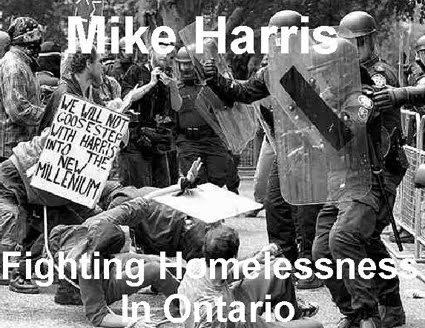
Like most neoconservative governments, Mike Harris's created the highest number of homeless people in the history of our province. And what was worse, he didn't care. One of his henchmen, Jim Flaherty, simply suggested that we throw them all in jail.

And if a person froze to death living in their car, at least they had a car.

Ford is already talking about selling off public housing in Toronto. Maybe he hopes to drive the poor out of his city, but will only drive them into the streets.


Hudak wants to eliminate or drastically reduce the public service, suggesting that because they make a good wage, small businesses can't compete with government in the labour market. What the fool doesn't realize is that those good wages keep many small businesses afloat.

When Mike Harris ran Ontario, we had a Liberal government federally. When Brian Mulroney was prime minister, we had Liberal and NDP governments in Ontario.

If Hudak takes Ontario, there will be no counterweight.

It's absolutely terrifying.

Tuesday, June 7, 2011

Calgary School, Chicago School and the Committee on Social Thought


Canada's neoconservative movement has been slow to reach awareness in Canada, though throughout the 1990's, neoconservatism was a term used by many journalists and political pundits, to separate the conservatism of people like Mike Harris in Ontario, Ralph Klein in Alberta, Grant Devine in Saskatchewan and the Reform Party on the national scene; from the more traditional conservatism.

However, since Stephen Harper's "new" Conservative Party came to power, the mainstream media prefer to use the misnomer "Tory". A term that Stephen Harper himself, claimed to detest. "It's not my favourite term, but we're probably stuck with it." (Stephen Harper, Hamilton Spectator, January 24, 2004)

We are more familiar with American neoconservatism (on which our own movement is based), as represented by George W. Bush and his war mongers, and the free marketeers, who push deregulation, low or no corporate taxes, and the end of the welfare state.

However, the political philosophy is not simply about imperial wars or free market theories. It is a complete doctrine designed to change the way that we view the role of government.

Not a government that Abraham Lincoln famously claimed as being "of the people, by the people and for the people", but a government that is only there to serve the interests of profit.

The National Citizens Coalition, of which Harper has been a member for more than three decades, and once served as president, espouses the Milton Friedman theory of eliminating government altogether, except for "policing and the military" (1).

Policing to ensure that the poor don't touch the rich people's stuff, and the military, so we can lay our hands on the stuff belonging to the poor of other nations.

And this theory was galvanized at the University of Chicago, almost 60 years ago.

The Chicago School

In 1963, Time magazine ran a piece about the University of Chicago: The Return of a Giant, where they spoke of the difference a decade had made to the school.
In 1953 the University of Chicago was so close to academic anarchy that its graduate schools refused to honor degrees from its college, and only 141 freshmen entered the place. The limestone Gothic campus was marooned in a sea of slums and muggers; the trustees morosely considered moving the university out of Chicago. To sum up his problems, Chancellor Lawrence A. Kimpton told a story: "A Harvard professor about to come here went to his young son's room the night before they left Cambridge. The boy was praying: 'And now, goodbye, God. We're going to Chicago.'" (2)
What saved the school was a change in direction.

They couldn't compete for the academic liberalism of places like Harvard, so instead chose to create an academic conservatism, "where "classical" Economist Friedrich von Hayek ... [and] conservative Milton Friedman" became "Chicago's answer to Harvard's liberal John K. Galbraith."

However the economics of Friedman and Hayek, were not palpable to most Americans, and since they couldn't be pushed through the barrel of a gun, as happened in places like Chile and Argentina, it became necessary to change the way that people think.

And as sci-fi as that sounds, they set out to accomplish this with scholars, including Leo Strauss and Hannah Arendt, who were encouraged to think outside the norm.

The Committee on Social Thought

The graduate studies in unorthodox thinking, had its own outpost:
The oddest graduate school in the U.S. is a far-out arm of the University of Chicago called the Committee on Social Thought. Physically, it is a dingy office under the eaves of the social science building. Its faculty, which includes Novelist Saul Bellow and Political Scientist Hannah Arendt, numbers only eleven. But its goal is as big as the world ... The committee is a generalist's elysium, a haven for "eccentrics" commanded to "think in new areas." If they do, the school gives them the degree of Doctor of Social Thought. (3)
Not all graduates churned out conservative essays, but the ones who did, very much changed the way the U.S. government did business.

In fact, one graduate who studied under Leo Strauss, the late Irving Kristol, called himself the "Godfather of Neoconversation".

He and scholars like him, flooded the market with books and essays, promoting free markets, and the freedom of the individual, including the freedom to be poor and sick, so long as you didn't expect the government to do anything about it.

The Calgary School

The first to use the term The Calgary School, as the Canadian equivalent of The Chicago School, was David J. Rovinsky, who wrote a paper for the Washington based Center for Strategic and International Studies, entitled: THE ASCENDANCY OF WESTERN CANADA IN CANADIAN POLICY MAKING.

In the paper he confirms that neoconservatism is more than just an economic theory, but a political argument, and that the Calgary School is part of an "international neoconservative movement".

So while Stephen Harper and his government have adopted the economic principles of Milton Friedman and Friedrich von Hayek, they represent something more profound.

An increasingly successful attempt at social engineering.

They want to completely change the way we view ourselves culturally and historically.
The rise of the west as a potent force in Canadian political life has had several consequences. It has turned federal and provincial governments toward fiscal conservatism, deficit reduction, and state retrenchment; led a reexamination of policies related to immigration and multiculturalism; and exposed the scope of judicial activism in the wake of the 1982 Canadian Charter of Rights and Freedoms to new political debate. Most important, it has induced the rest of English-speaking Canada to take a new hard line on the question of recognizing Quebec’s distinctiveness in the Canadian constitution, to the point of encouraging the French-speaking province to leave the federation. Western Canada’s embrace of classical liberalism, together with its increasing demographic weight within the country, has the potential to make Canadian political debate in the early 21st century much different, and probably less distinctively Canadian, than it was for the bulk of the 20th. (4)
And The Calgary School is helping to accomplish that.

Like The Chicago School, they challenge civil rights and what they term "judicial activism". In Chicago, law professors "lambasted the U.S. Supreme Court for being "a policymaker without proper judicial restraint. (2)"

And Stephen Harper in 1997, told leading American Conservatives, "And we have a Supreme Court, like yours, which, since we put a charter of rights in our constitution in 1982, is becoming increasingly arbitrary and important ... "

I often quote a line that appeared in the Vancouver Sun several years ago, describing Harper's Reform Party:
"Reform is somewhat un-Canadian. It's about tidy numbers, self-righteous sanctimoniousness and western grievances. It cannot talk about the sea or about our reluctant fondness for Quebec, about our sorrow at the way our aboriginal people live, about the geographically diverse, bilingual, multicultural mess of a great country we are."
The Reformers, or more specifically, the neoconservatives, do not want us to "talk about the sea, our reluctant fondness for Quebec or our sorrow at the way our aboriginal people live".

So instead they create alternative Canadian stories, not the least of which is Calgary School's Tom Flanagan's book First Nations, Second Thoughts. In it he diminishes the importance of our First Nations, reducing them to just another band of immigrants.

But he is not the only Calgary scholar to try to change our history or the way we view ourselves. According to Rovinsky,
A look at classical liberalism among western intellectuals almost necessarily begins with David Bercuson and Barry Cooper. Bercuson, a University of Calgary historian, and Cooper, a political scientist at the same institution, each have a track record of publishing that features interest in neoconservatism and the Canadian west as a region. Bercuson has written a number of pieces on regionalism, and edited Canada and the Burden of Unity. Cooper has co-edited a book of comparative essays on neoconservatism in English-speaking countries and has written a stinging critique of the Canadian Broadcasting Corporation (Bercuson 1977, 1981; Cooper 1988, 1994). Yet they truly established their notoriety with their 1991 book Deconfederation: Canada Without Quebec. They state openly that the most important issue for constitutional reform is the preservation of Canada as a liberal democracy rooted in individual rights. The most significant threat to liberalism in Canada is Queberes call for special status and recognition of collective rights rooted in culture ...
And again to Harper:
"The establishment came down with a constitutional package which they put to a national referendum. The package included distinct society status for Quebec and some other changes, including some that would just horrify you, putting universal Medicare in our constitution, and feminist rights, and a whole bunch of other things." (5)
This shows that the Calgary School is alive and well in the Harper government. And before suggesting that Harper has abandoned his views on Quebec, we have to remember another Flanagan goal "how to convince Canadians that we are moving to the left, when we are not".

However, there is a more important book written by the Bercuson/Cooper team: Derailed: The Betrayal of the National Dream. In it they lay out the agenda, in a 'head in the clouds' idealism.
Bercuson and Cooper divide Canadian history into periods of good government and bad government, the latter broadly covering the Pearson, Trudeau, and Mulroney governments. Good government essentially refers to a government that worries about economic growth and that assumes that other good things, like national unity and social harmony flow from abundant material wealth. (4)
I guess they didn't hear the old adage that "money is the root of all evil".

Because the problem with this philosophy, is that "abundant material wealth" is concentrated at the top, and the "trickle down" theory, a myth.

It's important to view neoconservatism in the big picture of excessive greed and human suffering.

Naomi Klein's The Shock Doctrine: The Rise of Disaster Capitalism, does an excellent job of exposing this. It was written in 2007, before the Wall Street induced "economic crisis", engineered to put the final nail in the coffin of the welfare state.

The Opposition has got to change their strategy, by changing the channel. When was the last time that healthcare was debated? I mean really debated?

When asked, Flaherty will stick to his one liner "we are not going to alter the transfer to the provinces." Not a word on protecting the Canada Health Act, that guarantees the right to universal healthcare for all citizens.

We have to understand that the neocon way is not the Canadian way. It is the American Republican way. The Calgary School way.
"Westerners, but especially Albertans, founded the Reform/Alliance to get "in" to Canada. The rest of the country has responded by telling us in no uncertain terms that we do not share their 'Canadian values.' Fine. Let us build a society on Alberta values." Stephen Harper
Getting rid of Stephen Harper anytime soon, is unlikely, but remember this. The Calgary School is already grooming Pierre Poilievre as his replacement. Oye!


Sources:

1. The Myth of the Good Corporate Citizen: Canada and Democracy in the Age of Globalization, By Murray Dobbin, James Lorimer & Company, 2003, ISBN: 1-55028-785-0, Pg. 200-203

2. Universities: Return of a Giant, Time magazine, May 31, 1963

3. Universities: Generalist's Elysium, Time Magazine, January 03, 1964

4. THE ASCENDANCY OF WESTERN CANADA IN CANADIAN POLICY MAKING, By David J. Rovinsky, Policy Papers on the Americas, February 16, 1998, Volume IX Study 2

5. Full text of Stephen Harper's 1997 speech, Canadian Press, December 14, 2005

Sunday, May 29, 2011

Milton Friedman and the Destruction of Argentina


A CULTURE OF DEFIANCE: History of the Reform-Conservative Party of Canada

It is just as important to study Milton Friedman as Leo Strauss, in understanding Canada's neoconservative movement.

Friedman is one of the authors of the "shock therapy" economic system, where disasters are created or exploited, by the corporate sector. Free Marketeers will call it progress. Others see it as shocking and inhumane.

Because in order for the U.S. to control a foreign nation's economy, an authoritarian is needed, and that authoritarian is often a ruthless dictator. Case in point, Augustus Pinochet in Chile.

If you read Lawrence Martin's Harperland, or Christian Nadeau's Rogue in Power, you'll see how Stephen Harper took control, using ruthless means, and is now in a position to implement Friedman's policies. A bloodless coup.

Argentina's Shock Therapy

In her memoirs, Margaret Thatcher says of Argentina:
Whatever the Argentineans thought about it at the time ... the Falklands War provided a shock which brought first democracy and more recently, under President Menem, the economic benefits of free-market policies. Inflation has been brought down and a far-reaching privatization programme has been undertaken. Subsidies, regulation and tariffs have all been cut. Economic growth has sharply accelerated.
A little "shock" was good for them, says the lady who once declared that there was "no such thing as society".

In their book Commanding Heights, Daniel Yergin and Joseph Stanislaw, provide a bit of insight into the pre-coup Argentina, and what Thatcher called a "black economy".
Argentina had long been an economic paradox. How did a country that was one of the world's richest in the first decades of the twentieth century, end up in such economic disorder? A good part of the answer rested with Juan Peron. He is now best remembered, of course, as the husband of Evita, but in the years after World War II he was the embodiment of populism with an almost fascist tinge. Building on the prewar popularity of fascist ideas, Peron turned Argentina into a corporatist country, with powerful organized interest groups, big business, labor unions, military, farmers—that negotiated with the state and with each other for position and resources. He incited nationalist passions, stoked pretensions of grandeur, and pursued stridently anti-American policies. He nationalized large parts of the economy and put up trade barriers to defend them. He cut Argentina's links to the world economy which had been one of its great sources of wealth—embedded inflation in the society, and destroyed the foundations of sound economic growth. (2)
Viewed through a free-market lens, Peron would have been a disaster. So many opportunities for profit going to waste.

Peron was no saint, but according to Namomi Klein in The Shock Doctrine, life for Argentines was not as bad as suggested. Protectionism made many things unaffordable ($2000 just to install a phone), but the welfare state was alive and well. And like Chile, before their U.S. financed coup, the country had just undergone an intellectual revolution, where the arts thrived.

By the 1950s, Argentina had the largest middle class on the continent. Juan Peron had introduced Keynesian style economics "pouring public money into infrastructure projects such as highways and steel plants, giving local businesses generous subsidies to build their new factories, churning out cars and washing machines, and keeping out foreign imports with forbiddingly high tariffs." (3)

Naturally, this was anathema to the free marketeers, and when Peron died and his widow Isabel named leader, they sprang into action. From Henry Kissinger's records, recently made public, we learn that the U.S. were behind the 1976 coup that initiated the Argentine shock therapy.

Wages fell to 40% of what they had been and poverty became the norm.

But worse, was the wave of terror, under the planted dictator, General Jorge Videla, that followed the Chilean blueprint, to the Milton Friedman letter. According to Klein's Shock Doctrine:
When someone was targeted to be eliminated, a fleet of military vehicles showed up at that person's home or workplace and cordoned off the block, often with a helicopter buzzing overhead. In broad daylight and in full view of the neighbours, police or soldiers battered down the door and dragged out the victim, who often shouted his or her name before disappearing into a waiting Ford Falcon, in the hope that news of the event would reach the family.

Some "covert" operations were even more brazen: police were known to board crowded city buses and drag passengers off by their hair. In the city of Santa Fe, a couple was kidnapped right at the altar on their wedding day in front of a church filled with people."

The public character of terror did not stop with the initial capture. Once in custody, prisoners in Argentina were taken to one of more than three hundred torture camps across the country. Many of them were located in densely populated residential areas; one of the most notorious in a former athletic club on a busy street in Buenos Aires, another in a schoolhouse in central Bahia Blanca and yet another in a wing of a working hospital. At these torture centres, military vehicles sped in and out at odd hours, screams could be heard through the badly insulated walls and strange, body-shaped parcels were spotted being carried in and out, all silently registered by the nearby residents.

The Argentine junta was particularly sloppy about disposing of its victims. A country walk could end in horror because mass graves were barely concealed. Bodies would show up in public garbage bins, missing fingers and teeth (much as they do today in Iraq), or they would wash ashore on the banks of the Rio de la Plata, sometimes half a dozen at a time, after one of the junta's "death flights." On occasion, they even rained down from helicopters into farmers' fields."

All Argentines were in some way enlisted as witnesses to the erasure of their fellow citizens, yet most people claimed not to know what was going on. (much like Nazi Germany). There is a phrase Argentines use to describe the paradox of wide-eyed knowing and eyes-closed terror that was the dominant state of mind in those years: "We did not know what nobody could deny." (4)
As Canada is now in the throes of its own shock therapy, the need for torture chambers are not necessary.

We have our authoritarian leader in Stephen Harper, who allows no dissent. Witch hunts are now the norm, and while people don't disappear, their careers are ruined or threatened, if they dare to challenge.

The G-20 saw the worst human rights abuses and mass arrests in Canadian history; and police brutality at protests like the one over the Prison Farm closures, saw no age barrier. Those from 14 to 88 were victimized.

We are now part of the Shock Doctrine under the Harper regime, and what is happening in our country is just as shocking to many, as they were in places like Chile and Argentina.

And "the paradox of wide-eyed knowing and eyes-closed terror", was evident, when despite the horrors of the G-20, many Canadians simply shrugged and said "you should have stayed home".

Sources:

1. The Path to Power, By Margaret Thatcher, Harper Collins, 1995, ISBN: 0-06-017270-3, Pg. 583

2. The Commanding Heights: The Battle for the World Economy, By Daniel Yergin and Joseph Stanislaw, Touchstone, 2002, ISBN: 0-684-82975-4, Pg. 242

3. The Shock Doctrine: The Rise of Disaster Capitalism, By Naomi Klein, Vintage Canada, 2007, ISBN: 978-0-676-97801-8, Pg. 63

4. Klein, 2007, Pg. 106-107

Friday, May 27, 2011

The Deficit Cure: Acupuncture or Shock Therapy?


When the neoconservative movement in Canada first appeared on the radar of many journalists, it was tied to the administrations of Margaret Thatcher and Ronald Reagan. Both of these leaders launched aggressive attacks on the welfare state, and left devastation in their paths.

Grant Devine in Saskatchewan, Ralph Klein in Alberta and Mike Harris in Ontario, all sought to experiment with the Thatcher/Reagan theories in their respective provinces.

On the federal scene, the Reform Party had their ideology in check, and were just waiting for their turn.

At the time, Thatcher and Reagan were not on tour, so Canada's neocons were taught strategy by New Zealand politician, Roger Douglas.

He held information seminars, speaking to the Harris caucus in Ontario, with Tony Clement, John Baird and Jim Flaherty in attendance; and Klein's in Alberta, indoctrinating Stockwell Day.

But the most important lecture, when it comes to the future of Canada, was presented to the Reform Party of Preston Manning and Stephen Harper, at their 1991 Assembly.
Douglas was introduced by Preston Manning, the only assembly speaker to be so honoured. And Manning told the delegates: There are three basic reasons why we have invited Sir Roger Douglas to be with us ... and three reasons why Reformers should pay close attention to what he has to say ... Sir Roger is an authority in fiscal reform and has advocated and promoted many of the fiscal reforms ... He is not only a reformer in word, he is a reformer in deed. Sir Roger deregulated the financial sector, phased down agricultural and other subsidies .. phased out import controls and drastically reduced tariffs levels. He instituted a 10% flat rate consumption tax (GST)*, with virtually no exemptions ... (1)
And Roger Douglas's most important message to his followers was "don't blink". Once you start cutting, keep going.

And if you developed a case of blepharospasm, uncontrollable eye blinking, a little acupuncture would fix you right up.

Because what Douglas failed to mention was how his policies affected New Zealand.
Dr. John Warnock, travelled to New Zealand to study the effects of what New Zealanders dubbed 'Rogernomics.' The figures tell a story of devastation - a word used by New Zealand's own agricultural minister to describe the state of agriculture in four years after the 'reforms': A 40 per cent drop in farm income; a 50 per cent drop in the value of farm land; a policy of paying 3,000 farmers incentives of $ 45,000 to leave and the suggestion that another 15,000 (out of 79,000) should follow them. Unemployment, which had been at 4 per cent before Douglas's reforms, jumped to over 12 per cent in just over a year and is still increasing.

"Douglas completely eliminated regional development grants and subsidies to rural services. Says Warnock, 'They had things like subsidized petroleum - regardless of where you were the price was the same - subsidized train service, bus service, airport service. They privatized all these things and the prices immediately skyrocketed.' A massive de-population of the countryside resulted, and approximately 40,000 New Zealanders per year have since left the country for Australia to find work ... (1)
He should have blinked.

Shock Therapy

While Roger Douglas may present us with a little trip down memory lane, Stephen Harper and Jim Flaherty will probably forgo acupuncture for shock therapy.

This is the remedy prescribed by Milton Friedman, and articulated at places like the Fraser Institute. Friedman believed in taking advantage of disasters, like Katrina, but when none presented themselves, they could simply be created.

His most famous induced disaster, was the Chilean experiment.

In 1970, when a socialist, Salvador Allende, was elected president, many of Chile's elite, were not pleased.
Allende, a physician by training, understood the cost that malnutrition imposed upon the poor and set out to alleviate the grinding poverty in which so many Chileans were trapped. He ensured that every Chilean schoolchild had access to at least a half-liter of milk each day, and that their parents had access to jobs and the means to feed and educate their children. Median incomes began to rise dramatically in the first two years of Allende's term.

To pay for these social programs designed to create opportunities for the poor, rich Chileans who had lived all their lives off of rents, dividends and interest and who had never paid a dime in taxes, found themselves paying taxes for the first time and being forced to morally justify their lives of luxurious leisure at the expense of the poor. They didn't like it one bit. And they began to complain to their friends in Washington. (2)
Fortunately for them Washington was already aware of the situation, and with the help of several corporations, engineered a coup to oust Allende and place the murderous Augustus Pinochet in the presidential palace.

Friedman then took over, encouraging Pinochet to implement "shock therapy" on the people of Chile.
Friedman advised Pinochet to impose a rapid-fire transformation of the economy—tax cuts, free trade, privatized services, cuts to social spending and deregulation. Eventually, Chileans even saw their public schools replaced with voucher-funded private ones. It was the most extreme capitalist makeover ever attempted anywhere, and it became known as a "Chicago School" revolution, since so many of Pinochet's economists had studied under Friedman at the University of Chicago. Friedman predicted that the speed, suddenness and scope of the economic shifts would provoke psychological reactions in the public that "facilitate the adjustment." He coined a phrase for this painful tactic: economic "shock treatment." In the decades since, whenever governments have imposed sweeping free-market programs, the all-at-once shock treatment, or "shock therapy," has been the method of choice. (3)
And though Friedman and his Chicago School are still being hailed as heroes by Neoliberals/Neoconservative/Free Marketeers everywhere, his remaking of Chile was an absolute failure.
.. The country's period of steady growth that is held up as proof of its miraculous success, did not begin until the mid-eighties, a full decade after the Chicago Boys implemented shock therapy and well after Pinochet was forced to make a radical course correction.

That's because in 1982, despite its strict adherence to Chicago doctrine, Chile's economy crashed: its debt exploded, it faced hyperinflation once again and unemployment hit 30 percent—ten times higher than it was under Allende. The main cause was that the piranhas, the Enron-style financial houses that the Chicago Boys had freed from all regulation, had bought up the country's assets on borrowed money and run up an enormous debt of $14 billion.

The situation was so unstable that Pinochet was forced to do what Allende had done: he nationalized many of these companies. In the face of the debacle, almost all the Chicago Boys lost their influential government posts. (4)
So despite the fact that both of these experiments in economic reform were catastrophes, we know that it will not change Flaherty's or Harper's ideology.

Canadians will probably be subjected to a little "shock" in the upcoming budget, or if not then, in the not too distant future. The convoluted belief being that if we associate pain with social programs, we will not be too quick to want to reintroduce them (Friedman was a nut), especially if they convince us that they have been replaced with something better.

Poverty being good for the soul.

So slap on the electrodes boys. I'm ready.

Footnotes:

*The Reform Party was conflicted about the GST, with most wanting it scrapped if they came to power. Harper himself convinced them to keep the GST but eliminate any exemptions.

Sources:

1. Preston Manning and the Reform Party, By Murray Dobbin, Goodread Publishing, 1992, ISBN: 0-88780-161-7, pg. 113-114

2. Free Market Fundamentalism: Friedman, Pinochet and the "Chilean Miracle", By Scott Bidstrup

3. The Shock Doctrine: The Rise of Disaster Capitalism, By Naomi Klein, Vintage Canada, 2007, ISBN: 978-0-676-97801-8, Pg. 8

4. Klein, 2007, Pg. 123

Tuesday, March 29, 2011

The Remaking of Canada. Are we Really Prepared for This?


Like many people living in Canada, I am ashamed of our current government. I am ashamed and I am appalled by the actions it has undertaken, and continues to undertake, in our name. I have never been particularly patriotic, but I do have a Canadian passport and I do pay taxes to the Canadian state. By virtue of these simple facts, I am responsible, like any citi­zen, for my government's initiatives. For this reason, I have to take action because feeling ashamed is not enough. I have to understand who I am dealing with, exactly what it is that they want, and why this government, with considerable success to date, is changing the face of our Canadian institutions.
That is the opening paragraph to Christian Nadeau's new book, Rogue in Power, and his words are chilling. I've often wondered myself just what Stephen Harper does want with us, and why a majority is so necessary, given the enormous amount of control he currently has over every aspect of government, and all Canadian institutions.

In fact, can I still call them 'Canadian institutions', or are they 'Harper institutions' now? Much of the political discourse today centers on the bogey-man coalition, with the Harper team keeping it alive to deflect attention from other things, like their Contempt of Parliament charge. And unbelievably, there are many in the media applauding his strategy. But what is that doing to our democracy?

During an election campaign we should be presented with the issues and that's the only thing that should matter. Yes, politics is a blood sport, and attack ads par for the course, but the Conservatives have been engaged in visceral assaults on their adversaries for five years, especially on the Liberals. As Andrew Cohen writes in the Ottawa Citizen:

There is a story of a meeting between Stephen Harper and a visiting head of government. During the conversation, which took place in the Prime Minister's Office, the two leaders eventually discussed the parliamentary opposition in their respective countries. What struck the visitor was Harper's antipathy toward the opposition, particularly the Liberals. "I don't like my opponents," the visitor allowed afterwards, "but I don't hate them. He hates his opposition!"


Hatred is a strong word. Whenever we spat "I hate you!" in the schoolyard, teachers told us to watch our tongues; you disliked the bully who washed your face with snow, but, really, you didn't hate him. You have to wonder about how little personal regard Stephen Harper has for his opponents and how it affects how he runs a government and fights an election. More than any other politician in this country, this is a man with animus.

Others in his circle have said that he can't be nice. "It's not in his DNA".

We know that the coalition flap has a shelf life, and after that I shudder to think what his next move will be. To date his policies are only getting negative attention. Can we expect even more poisonous darts thrown Ignatieff's way?

The fact that he's still standing says something of the Liberal leader's strength of character. I'd have been reduced to whimpering mass months ago.

Ezra Levant already wrote of an Ignatieff ancestor who was anti-Semitic. How relevant that is today is beyond me. When I was doing my family history, I discovered that some of my Acadian ancestors, who helped to settle Louisiana, owned slaves. It hardly makes me embrace slavery.

But what does all of the poison, all of the anger, the hatred, the bullying, the secrecy and contempt, really mean? What is the endgame? Is it simply power or is it something more? Nadeau believes that "the primary danger represented by the Conservatives lies in their profound belief in certain ideas and values and in their willingness to impose those ideas and values on Canadians." But I think that's only part of it.

Tom Flanagan has said in the past that Stephen Harper himself is not a social conservative. He only sees the Religious Right in his party as a means to an end. But he is willing to allow them to impose their version of morality on the rest of us, for his sole benefit. His new tax plan for families, only helps the nuclear family. Husband, wife, children. Not single families, same-sex relationships or any other configuration. This is clearly written to draw that conservative Christian-Judeau support. They are the ones with the websites and mailing lists who can bring him the votes.

Most religious organizations are worried about the poor and homeless, not whether gays want to marry and raise families.

This same strategy, was no doubt behind his decision to drop license fees on guns, which will reduce our revenue by $21 million. Gun enthusiasts see his party as the only one willing to take up their cause. It's interesting that the budget only mentions 'sports shooters' and 'hunters'. Not farmers this time.

So if all of his policies are designed for the sole benefit of religious fundamentalists and the gun totin' crowd, what happens to the rest of us? And why should we care?

There is a reason why Stephen Harper draws on the radical right for support, and it has nothing to do with his moral values. His is a government that operates solely for the benefit of multinational corporations. Canada or Canadians rarely cross his mind, except to exploit for political gain, in a fierce, albeit ambivalent nationalism.

In the video provided at the bottom of the page, you'll hear Harper first tell the Canadian media that we will not be expected to "surrender our sovereignty", yet in his speech to the G-20, he's pretty clear that he understands why people oppose the notion of global governance, because it "means a loss of national sovereignty". He also goes on to say that there is no longer a Canadian economy only a global economy.

Did we miss the memo? Or do Canadians really not care if we are still a united Canada? For all the hoopla over the Bloc wanting to break us up, it would appear that there may be nothing to break up. His speech certainly doesn't sound like a commitment to this country. His only commitment is to a Global economy. Multinational corporations.

Policy is designed to keep us passive. And if he can't pacify us, he'll turn us off the entire process, by making Parliament so toxic we no longer have the will, or even the desire, to save ourselves.

Journalist Russell Wangersky has a suggestion: "So, while you’re out there, caring about your wallet and the economy and little else, ask yourself this: regardless of how you’re going to vote, is that the kind of place you really want to live? It’s certainly a different country than the one I grew up in, and treasure."

We cannot give this man another mandate. It's that simple. Sources:

1. Rogue in Power: Why Stephen Harper is remaking Canada by Stealth, By Christian Nadeau, Lorimer Press, ISBN: 978-1-55277-730-5


Wednesday, December 29, 2010

My Conversation With Irving Kristol on Welfare and Wages


A CULTURE OF DEFIANCE: History of the Reform-Conservative Party of Canada

The late Irving Kristol (d. 2009) was a self-proclaimed Straussian and by his own labelling, the "Godfather of Neoconversation". He wrote a series of essays and books that became the basis for the movement.

In one he discusses "welfare" or "relief" and why he finds the concept absurd. I would like to challenge Mr. Kristol, because I find his arguments absurd.

Leo Strauss often had "conversations" with Plato, or at least at times his challenges and insights read like conversations, so I would like to converse with and challenge Irving Kristol.

I realize that he was an intellectual and certainly out of my league, but I'm going to invoke Hannah Arendt in The Human Condition. "What I propose, therefore, is very simple: it is nothing more than to think what we are doing."

There is too much compliance to what we are told is good for us, and not enough thinking. Because when you break it down, it's pretty simple.

We are continually transferring huge amounts of money to a government who is supposed to be using that money for the betterment of all citizens, and instead are using the money for the betterment of a chosen few.

And that is something, I "think" about often.

Essay on Pauperism
"In terms of the unemployed, of which we have over a million-and-a-half, don't feel particularly bad for many of these people. They don't feel bad about it themselves, as long as they're receiving generous social assistance and unemployment insurance. " - Stephen Harper (1)
Irving Kristol begins his musings on welfare by invoking Alexis de Tocqueville's, 1835 Essay on Pauperism. Tocqueville asks why, in the most "opulent" nation in the world [England], was there such an extraordinary problem of "pauperism".

Concluding that too much public assistance can create idleness, he and Kristol also see a problem with the definition of poverty or pauperism. To the peasant, the ultimate goal was to have enough to eat. There was no desire to accumulate wealth. The only concern was survival.

However, in a modern city, the standards were different.

... in an "opulent" society, the idea of poverty itself undergoes a continual redefinition. The poor experience not only the need for a guaranteed minimum; they also suffer from what a modern sociologist would call "relative deprivation." Tocqueville puts the matter this way: "Among civilized peoples, the lack of a multitude of things causes poverty... In a country where the majority is ill-clothed, ill-housed, ill-fed, who thinks of giving clean clothes, healthy food, comfortable quarters to the poor? The majority of the English, having all these things, regard their absence as a frightful misfortune; society believes itself bound to come to the aid of those who lack them.... In England, the average standard of living a man can hope for in the course of his life is higher than in any other country of the world. This greatly facilitates the extension of pauperism in that kingdom." (2)

So the definition of poverty in the city, is different than that in the country.

The reasons for that, at least when this was written almost two centuries ago, was first off that those living in poverty in the city, had no land to work for food. But also their impoverishment was visible to those who took so much for granted.

How can you live conscience free, in a society with so much disparity?

The Welfare Explosion

The next body of work that Kristol critiqued was Regulating the Poor: The Function of Public Welfare by Frances Fox Piven and Richard A. Cloward. He calls their book "simpleminded", and "so crude in a quasi-Marxist way, that one is embarrassed to summarize it."

He scoffs at the notion from Piven and Cloward, that "Relief arrangements [under capitalism] are not shaped by the impulse to charity ... [they are] created and sustained to help deal with the malfunctions inherent in market economies."

Poverty in a modern society is often created by unemployment, and unemployment is often created when the "market economy" is in turmoil. The first to be cut by the corporate sector, during hard times, is the labour force, which creates a downward spiral.

The misguided notion that by giving more money to the corporate sector, jobs will be saved or created, has been proven over and over to be a myth. When companies were bailed out at the beginning of the latest "downturn", much of the money was used to give bonuses to executives and to buy up other companies that had gone bust.

Unemployment is still high, yet headlines in financial sections of newspapers, repeatedly include the words "record profits".

Piven and Cloward also wrote:
Relief arrangements are usually initiated or expanded in response to the political disorders that sometimes follow from the sharp economic downturns or dislocations that periodically beset market systems. The purpose of relief-giving at such times is not to ease hunger and want but to deal with civil disorder among the unemployed. (2)
Revolutions are often ignited by the lack of bread, real and metaphorical. And since Canada's crime rate is now at the lowest in our history, could this be why Stephen Harper is so intent on building more prisons?
"Are there no prisons? Are there no workhouses?" - Ebenezer Scrooge
So My Dear Mr. Kristol. This is What I "Think"
“These proposals included cries for billions of new money for social assistance in the name of “child poverty” and for more business subsidies in the name of “cultural identity”. In both cases I was sought out as a rare public figure to oppose such projects.” - Stephen Harper, (The Bulldog, National Citizens Coalition, February 1997)
Tocqueville also wrote that "There are two incentives to work: the need to live and the desire to improve the conditions of life." The basis of Neoconservatism or Libertarianism, is that everyone should look after themselves. But how can you find work when you have no clothing to wear, no food to eat, or no roof over your head?

Maybe if we take care of the first incentive, the second one will have a better chance of prevailing. We can always find money to give to Big Business or war, so there is no excuse not to channel a bit to our nation's disadvantaged, who might actually want to get out of the cycle of poverty.

Apparently the NDP and Conservatives are negotiating terms for the acceptance of the January budget. NDP finance critic, Thomas Mulcair, wants "future corporate cuts to be more targeted to ensure companies are investing in jobs and productivity."

"Future corporate tax cuts"? What happened to the NDP? Those terms should have been compulsory 50 billion dollars ago. From the day that Stephen Harper invited his corporate backers to slurp from the public trough. That is our money and we don't want "corporate tax cuts" that promise so much and give so little.

That money could have gone, and should be going, to actual job creation. If the NDP buy into this, they are going to lose most of their base.

Maybe they need to read Linda McQuaig's column: The growth of extreme inequality in Canada
The massive upward flow of income has largely been invisible to the public, even though it may well amount to the most significant change in Canadian society in decades. The impact on Canada's social fabric is huge and likely to grow. Recent research -- particularly the work of British epidemiologists Richard Wilkinson and Kate Pickett -- shows that less equal societies almost always have more violence, more disease, more mental health problems, higher infant mortality rates, reduced life expectancies, as well as less social cohesion. The effects are most pronounced at the bottom, but are evident throughout the society.
Or John Grace's review of the new book, Spirit Level, by Richard Wilkinson and Kate Pickett, that he wrote for the UK Guardian.
They say, it's not just the deprived underclass that loses out in an unequal society: everyone does, even the better off. Because it's not absolute levels of poverty that create the social problems, but the differentials in income between rich and poor.
That is the only issue that the NDP should be raising. Not what to do with "future corporate tax cuts".

Irving Kristol speaks of the fact that welfare payments were based on the poverty level, which means that they are at the same as the lowest wage earner's income. But the problem is not the amount of "relief" but the fact that wages are so low. There's no reason for it.

And if he felt that this meant that people wouldn't work, as a result, he might want to think about a national childcare plan, because often those on assistance are single parents, who can't work for poverty level wages, and pay someone else to look after their children while they work.

He also felt that welfare took away a man's masculinity: "... welfare robs the head of the household of his economic function, and tends to make of him a "superfluous man." And he suggests that if single mothers are paid to raise their children, they will stay single or get rid of their male partner.

Notwithstanding the inequality of that notion, the problem again relates not only to unemployment, but the ability of people to work. Food, clothing, shelter and childcare. Those needs must first be met.

And jobs paying higher than the poverty level, provide revenue from income tax, that can go to helping others to abandon their pauperism.

Yes, there will always be cheats, just as there will always be Big Business demanding more and more of our tax dollars, in some perverse sense of entitlement.

So my dear Mr. Kristol. Neoconservatism is failing society, but thanks for playing. And to my dear Mr. Mulcair. Give your head a shake.
"Courage, my friends; 'tis not too late to build a better world." - Tommy Douglas
Soures:

1. Full text of Stephen Harper's 1997 speech, Canadian Press, December 14, 2005

2. Neo-Conservatism: The Autobiography of an Idea, By Irving Kristol, The Free Press, 1995, ISBN: 0-02-874021-1, Pg. 43-49

Friday, December 17, 2010

One-Eyed Shieks and Holy Wars. How we Got it so Wrong


A CULTURE OF DEFIANCE: History of the Reform-Conservative Party of Canada

U.S. President Obama has come out this week suggesting that gains are being made in Afghanistan, though the progress is fragile.

In other words, they have no idea what they're doing.

U.S. intelligence supports my assessment.

The Americans drew the Soviet Union into invading the country in 1979, giving them their Vietnam, and are now caught in an unwinnable war that has gone on longer than the Soviet occupation, and threatens to continue for several more years.

15,000 Soviet soldiers were killed against about 1,000,000 Afghans, between 1979 and 1988.

And when you look at the rate of casualties in the American led invasion of Afghanistan, as represented by the chart below, we sure aren't fairing much better. And these are just the coalition forces. Thousand more civilians have fallen.


If the Americans wanted to give the Soviets their Vietnam, to weaken their military build up, they are getting it back. And while Stephen Harper has Canada trapped in the Afghan underworld, his answer is that he will now be directing the war himself, from the safety of his office. Rick Hillier calls it "crap!" I agree.

So How Did we Get it so Wrong?

The end of the Second World War brought on the Cold War, and the world's super powers spent enormous amounts of money building up an arsenal of advanced weaponry, in what Hannah Arendt described as an "apocalyptic chess game".
The technical development of the implements of violence has now reached the point where no political goal could conceivably correspond to their destructive potential or justify their actual use in armed conflict. Hence, warfare—from time immemorial the final merciless arbiter in international disputes—has lost much of its effectiveness and nearly all its glamour. (1)
It was a spy war as they all kept a close watch on each other, no one really wanting to use their weapons in what would have been a "universal suicide".

But this created another problem, because as the super powers became both omnipotent and impotent, smaller nations were left virtually unrestricted in the game of one-upmanship.
... in conventional warfare the poor countries are much less vulnerable than the great powers precisely because they are "underdeveloped," and because technical superiority can "be much more of a liability than an asset" in guerrilla wars. What all these uncomfortable novelties add up to is a complete reversal in the relationship between power and violence, foreshadowing another reversal in the future relationship between small and great powers. (1)
So the threats did not necessarily come from countries with nuclear capabilities, but from small groups "able to upset the strategic balance", by launching attacks that cost them very little.
And this bears an ominous similarity to one of political science's oldest insights, namely that power cannot be measured in terms of wealth, that an abundance of wealth may erode power, that riches are particularly dangerous to the power and well-being of republics. (1)
And since many of these new "armies" were stateless, who could the super powers wage war against? The CIA kept track of known terrorist cells, and did their best to keep them contained, but it was still presenting a huge problem for the military-industrial complex.

They had enormous weaponry but few targets, that allowed their use on any large scale.

Enter the Neoconservatives and Their "War on Terror"

In his 'Battlefields of the 1980s', General Andre Beaufre points out, that only "in those parts of the world not covered by nuclear deterrence" is war still possible, so the challenge for the Neoconservatives was to wage war in areas unrestrained by "nuclear deterrence".

But how to get Americans on board. They had already interfered in the affairs of the oil rich Middle East, but needed something bigger.

An enemy. A face. And fear.

Then 9/11 provided the perfect trifecta, though it was only the catalyst. The planning for this had been taking place for several years beforehand, when Bernard Lewis adapted Harvard political scientist Samuel P. Huntington's Clash of Civilizations, into a blueprint for war.

And through clever messaging, the American Neocons were able to sell the notion of an enormous Jihad. One launched by "savages" who had to be destroyed or their entire country would be demolished.

They "didn't start it", but they were sure going to finish it. Eyes lit up, keyboards clicked away and the landscape was awash in yellow ribbons. Meanwhile, the Bush administration used homey rhetoric to reach the masses, knowing that few intellects would find their theory of a massive Jihad against America logical.

Not that terrorism isn't real, but there are other ways of keeping it contained, without the senseless slaughter of so many.

The Blind Leading the Blind

Though Osama Bin Ladin went to his grave in 2001, denying any involvement in 9/11, he became the face of the war. Every now and then an actor would come out and make another tape, to keep fear at just the right level. It didn't make Bin Laden any less dead, but who was going to question?

However, even before Bin Laden became a household name, the Jihad against America had a leader. Omar Abdel Rahman, also called the "One-Eyed Sheik". He was apparently behind the 1993 attack on the World Trade Centre, which at the time, was not considered the work of a mastermind.

However, it did prove to be an embarrassment for the CIA and others, especially when the person who allegedly planted the bomb, returned to the rental agency requesting a refund because the van he rented blew up. (2) I know there's a lot more to that story, but suffice it to say they were not that organized.

But that didn't stop the Bush Administration from linking this incident to their notion of a massive Jihad.

In neoconservative Andrew C. McCarthy's book, Willful Blindness: A Memoir of the Jihad, we see just how they created a powerful enemy from several smaller "underdeveloped" ones, by using myths and creative language. And yes I do on occasion read books by neocons. It's the only way I can get inside Stephen Harper's head. (have you seen the movie Jacob's Ladder? It kinda' looks like that in there. I scream a lot)

He starts out complaining that the government's main focus after the 1993 incident, was handling the fall out. Aghast, he questions why, after "the most brazen attack against the American homeland since Pearl Harbour had taken place". (3) Really? Since Pearl Harbour?

He then fancifies Rahman, who was indeed a horrible man, and currently in prison with no chance of ever being released. But to equate him those who planned the attack on Pearl Harbour, is a bit of a stretch.

But then McCarthy reminds his readers of the seriousness of the situation. Intelligence and containment wasn't enough. This was "war".
In terms of actual national commitment, such wars translate into a somewhat higher priority than the dogged pursuit of tax cheats and corporate fraudsters. To be sure, jihad differs from Wars on Drugs, Poverty, Disease. Incivility, Intolerance, Greenhouse Gases, or whatever the next Flavor of the Month may be. Jihad, after all, actually does involve warfare: real bombs, real victims, and real death. But the distinction is lost when the side that declares only rhetorical war is exclusively on the receiving end of the blows ... (3)
America was the "victim". They had been taking all the blows, and never fought back. So forget all the other nonsense. Pardon the corporate fraudsters (as George Bush did). Forget about poverty, disease and Global Warming (as George Bush did). Heck you could even forget being civil to each other.

Every waking moment and every red cent had to be put into fighting this Jihad. (as George Bush did)

And where did it get them? Iraq is in a mess and Afghanistan has been taken over by the criminal element. They are still chasing ghosts, while all but ignoring domestic problems, that are spiralling out of control.

And to top it off, the Jihadists are more powerful than ever, because the invasion has only increased the recruitment.

Again, Neoconservatism is the god that failed and we need to rethink this war.

Sources:

1. On Violence, by Hannah Arendt, Harvest Books, 1970, ISBN: 978-0-15-669500-8, Pg. 3

2. He wanted his money back: Insistence on a Refund for a Van Led to the Arrest of Blast Suspect, by Ralph Blumenthal, New York Times, March 5, 1993.

3. Willful Blindness: A Memoir of the Jihad, By Andrew C. McCarthy, Encounter Books, 2008, ISBN: 13-978-1-59403-213-4, Pg. 5